An acupressure mat offers unsupervised, fixed pressure at home; it explains safe use, cautions, and why a guided table session can fit different needs.





You’ve probably seen an acupressure mat recommended for easing back tension or helping you unwind after a long day. They’re not for everyone, though. Certain health conditions mean you should skip the spikes entirely. This guide breaks down what an acupressure mat actually does, who needs to steer clear, and gentler ways to get that same relief in 2026.
The idea behind the mat traces back to acupuncture and acupressure theory. That theory holds the body has specific points connected to muscle groups and energy pathways. Instead of needles, the mat uses hundreds of small plastic spikes arranged across a foam pad. You lie down on it, your body weight presses the spikes into your skin, and the theory says this stimulates those points enough to ease tension and trigger a relaxation response. Some people compare it to a controlled, bearable form of discomfort that eventually gives way to a dull, warm release.
There’s no needle, no oil, no practitioner involved. It’s just foam, plastic, and your own body weight doing the work. That simplicity is part of the appeal. Fans say ten or fifteen minutes on the mat can loosen a tight upper back or quiet a busy mind before bed. Skeptics point out that the evidence is thin and mostly anecdotal. Both things can be true at once, honestly.
Here’s the distinction that matters most: an acupressure mat is a self-use home product, not a professional treatment. You buy it once, roll it out on your floor, and manage your own experience with zero guidance beyond a pamphlet or a YouTube video. There’s no trained hands reading your posture, no adjustment mid-session, no one checking in on how your body is actually responding. It’s a tool, not a therapy appointment.
That matters because home tools and professional sessions solve different problems. If you’re searching for vibration therapy near me fort lee options, you’re likely looking for something supervised and calibrated to your body. A flat foam mat simply can’t offer that. Many local businesses blend hands-on techniques with equipment-based approaches precisely because a single static tool has limits. A mat can’t adjust intensity. It can’t skip a sore spot. It does the same thing every time, regardless of how you’re feeling that day.
That gap is really what this article is about. Over the next sections, we’ll stack the mat’s at-home pressure points against table-based approaches that use rhythmic incline and whole-body vibration instead, including how people weigh options when researching massage wellness near you bergen county for ongoing tension. One is a static object; the other is a guided, adjustable experience. Neither is automatically better. They’re just built for different moments.
Easing into the spikes matters more than people expect. Your skin needs time to adjust, and rushing the process is the main reason most people quit after one bad session.
Start with a thin barrier, not bare skin. A towel, a tee shirt, or a thin cotton sheet dulls the first wave of pressure enough to let your body adjust without flinching. Keep the first few sessions under ten minutes. Once that feels manageable, work up gradually.
If you carry a lot of tightness from a desk job, this kind of slow build matters. One helpful comparison point is learning how people manage massage for neck and shoulder pain through gentler, non-spiked methods first.
Mild discomfort is normal. Sharp pain isn’t. Two common mistakes cause most bad experiences: pressing too hard too soon by lying fully flat before you’ve built tolerance, and using the mat on broken skin, fresh scars, or inflamed, swollen areas where spikes can irritate rather than relax.
When in doubt, shorten the session or skip it. No mat is worth pushing through genuine pain for.
Most people reach for one of these mats for the same reason: hours of sitting have left their back and neck in knots. Desk workers are the biggest group by far. They describe lying on the spikes for ten or fifteen minutes and feeling the tightness between the shoulder blades ease up a bit. It’s not a cure. But as a cheap, at-home habit, it fills a real gap between workdays and whatever bodywork you can actually get scheduled.
Runners and casual gym-goers mention it too, usually for general soreness rather than anything specific. Some people also reach for it after a long drive, or after a weekend of yard work that left their lower back stiff. The appeal is mostly convenience: no appointment, no drive, just a few minutes on the floor before bed or after a workout. That’s worth something, even if it’s modest.
The relaxation claims come up constantly in reviews and forums. People say the sensation, somewhere between sting and pressure, pulls their focus away from racing thoughts for a few minutes. That shift alone can feel like stress relief, even without anything measurable changing in the body. A few describe it as a short, forced pause in a day that otherwise has none.
Others pair it with slow breathing or a few minutes of quiet, which tends to amplify the calming effect regardless of what’s happening on the mat itself. It’s a low-effort ritual, and rituals matter. If you’re weighing this against a longer, fully clothed relaxation session, it helps to understand how vibration massage back pain relief is reported to work, since the mechanism and the time commitment are quite different.
Some users report a warm, tingling feeling they associate with better circulation after lying on the mat, especially in the feet and lower legs. There’s no clinical measurement behind most of these accounts, just a sensation people find pleasant and repeat nightly. A handful say it helps them fall asleep faster when used as part of a wind-down routine before bed.
Worth saying plainly: these are self-reported experiences, not clinical outcomes. No peer-reviewed study backs the sleep or circulation claims in any strong way. If a specific ache, injury, or sleep problem is persistent, it’s reasonable to ask a doctor rather than rely on a foam pad covered in plastic spikes. For questions about what else might help with the same concerns, you can always contact us directly.
An acupressure mat is a do-it-yourself tool. You lie on fixed spikes and let your own body weight do the work. Cupping, trigger point therapy, and myofascial release sit in a different category entirely: they’re hands-on clinical techniques, performed by a trained practitioner who reads your body and adjusts pressure in real time. A mat can’t do that. It applies the same static pattern no matter what your muscles are actually doing underneath it.
Whole-body vibration and inclined traction work through motion, not pressure points at all. There’s no spike, no suction cup, no thumb digging into a knot. Instead, the table itself moves — vibrating from the feet up, or tilting and rocking the spine in a slow rhythmic pattern. If you’re curious about the research angle, it’s worth reading up on whole body vibration therapy benefits before deciding which category actually fits what you need.
Here’s a quick side-by-side to make the mechanism differences concrete rather than abstract:
| Method | How It Works | Who Applies It | Primary Goal |
|---|---|---|---|
| Acupressure mat | Static spikes, body weight | Self-applied at home | Localized pressure stimulation |
| Cupping | Suction on skin/muscle | Trained practitioner | Localized circulation, release |
| Trigger point therapy | Direct pressure on a knot | Trained practitioner | Release a specific muscle point |
| Myofascial release | Sustained hands-on stretch | Trained practitioner | Loosen fascia, improve glide |
| Vibration/inclined tables | Whole-body motion, no manual pressure | Self-select intensity on a table | General relaxation, circulation, decompression |
Read that table plainly: none of these are interchangeable. A mat targets points you press into yourself. Cupping and trigger point work target a specific spot someone else identifies. Myofascial release is a slow hands-on stretch. Vibration and traction tables skip pressure points altogether and work on the whole body at once. Different mechanism, different goal — mixing them up just leads to disappointment.
Worth stating directly: a dedicated provider offering wave and sonic table sessions does not offer acupressure, cupping, trigger point therapy, or myofascial release. If one of those hands-on techniques is specifically what you’re after, you’ll need a therapist trained in it. Motion-based therapy and pressure-point therapy are cousins, not substitutes.
A mat covered in plastic points looks harmless, but it’s still a pressure tool, and pressure tools aren’t right for everyone. Some caution is just common sense here, not fear-mongering.
The short version: if you fall into any of these groups, talk to your doctor before you add a pressure-based self-care tool to your routine. That’s true of a $20 mat and a $200 one. This caution is about the mat itself — it has nothing to do with table-based therapy studios, which work on entirely different principles and are addressed separately below.
Wave and Sonic Table sessions don’t use points, oils, or direct pressure, but they’re still physical therapies, and they still carry their own list of conditions worth flagging before you book. A good studio will ask about these upfront rather than let you find out the hard way.
None of this is medical advice, and no studio should pretend otherwise. It’s simply a plain-language contraindication list, the same way understanding wave and sonic massage therapy guide material helps you know what each stage actually does before you commit to a session. If you’re pregnant or in the early postpartum weeks, the right move is a licensed prenatal-trained massage therapist, not a mat and not a table. Skin issues matter too — if breakouts or irritation are part of what’s driving you toward self-care tools, a dermatology-reviewed piece on vitamin C for skin care is a reasonable place to look, alongside your doctor’s input. When in doubt, call ahead and ask; a quick glance at a services page plus a phone conversation will clear up most questions before you ever show up.
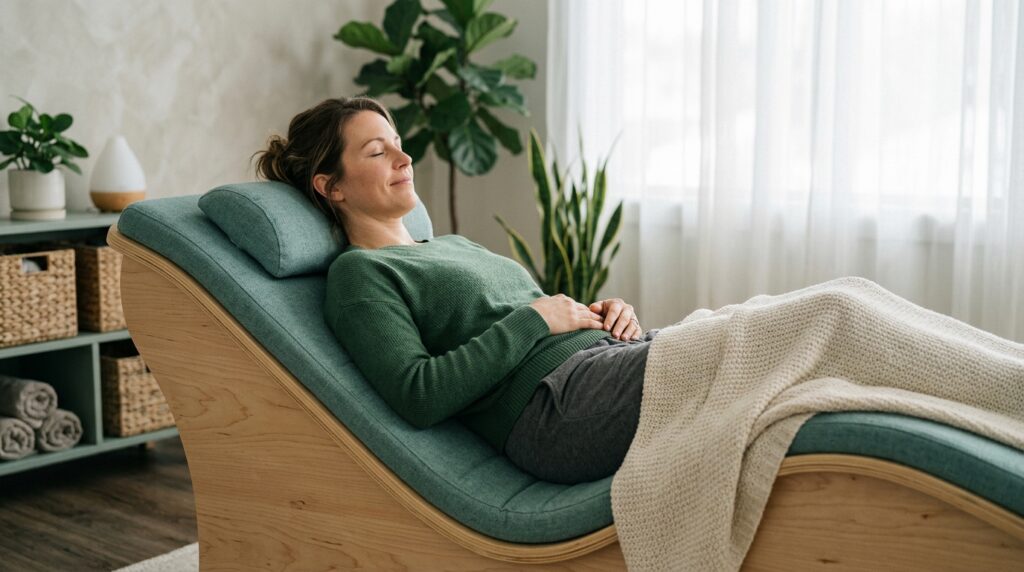
If spikes and pressure points aren’t your thing, there’s a fully clothed option worth knowing about. No oils, no mats pressing into bare skin, no need to undress at all. Intensity is adjustable on two of the three stages, so you’re never stuck with more pressure than feels right. It’s a different mechanism entirely, but the goal is the same: loosen what’s tight and help you relax.
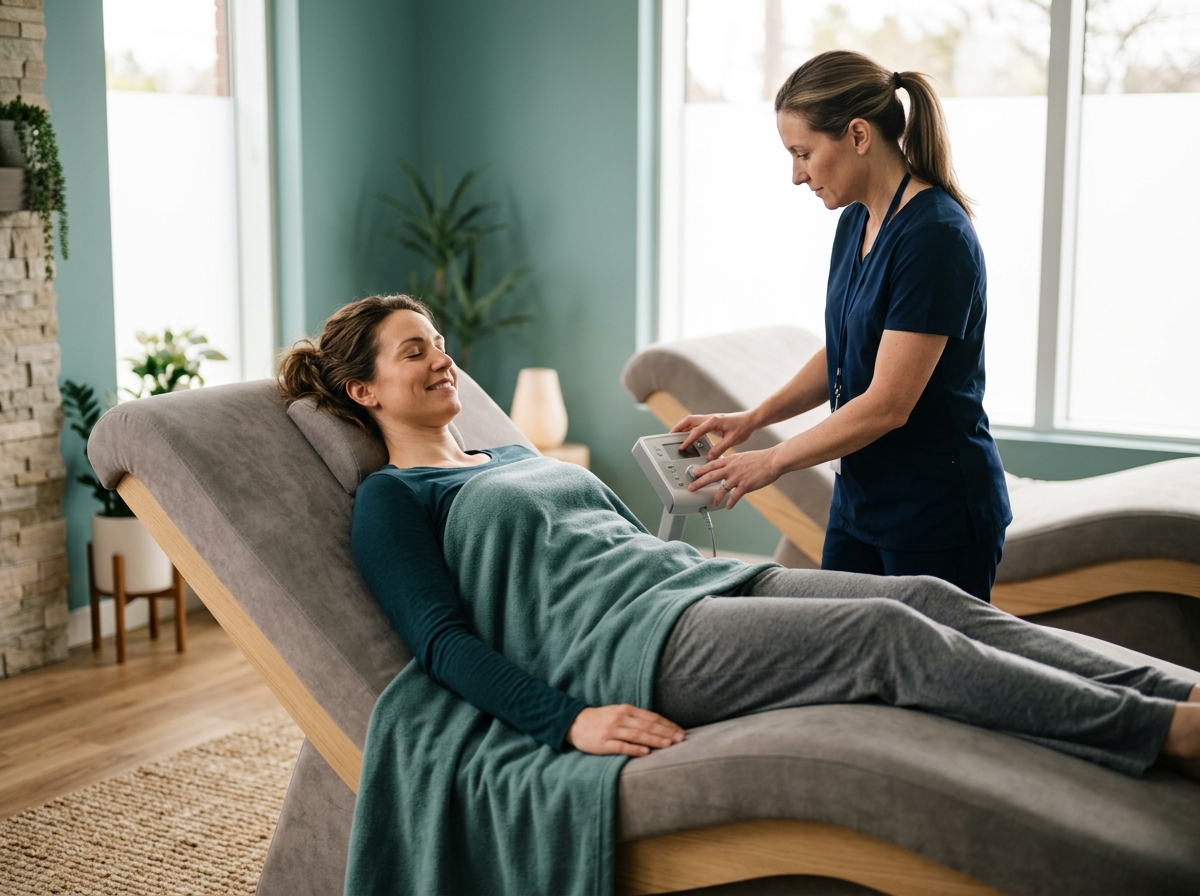
The session unfolds in three parts. First comes the Wave Table, a slow, rhythmic incline that gently decompresses the spine while a heated eye mask adds a bit of warmth and calm. Next is the Sonic Table, which sends vibration up through the body starting at the feet, an approach aimed at circulation rather than deep muscle work. The session closes with a short handheld massage focused on the back and shoulders, the one stage where a person adjusts pressure to whatever tension lingers after the first two.
Think of it as sitting somewhere between a stretch-based bodywork session and a vibration plate, without the hands-on stretching of the former or the gym-floor setting of the latter. It won’t replicate either exactly. That’s the point, really: a lower-intensity middle ground for people who want tension relief without committing to firmer techniques.
People who’ve tried this kind of session tend to mention a handful of things again and again: welcoming staff, a noticeably clean facility, and that specific stretching sensation during the Wave Table’s incline. Back pain relief and neck pain relief come up often too, especially among people who sit at a desk all day. None of that means it’s treating anything. It just means guests leave feeling looser than when they walked in.
For circulation specifically, there’s a reasonable case for whole-body vibration. If you want the research angle, it’s worth reading up on massage for better circulation before deciding whether this fits your goals. That’s different from what manual lymphatic drainage does, which relies on a trained therapist’s hands to move lymph fluid directly — the tables don’t do that, and no one running one should claim otherwise.
Worth repeating: this is a relaxation and circulation-support approach, not a treatment for any diagnosed condition. Anmowell asks guests who are pregnant, trying to conceive, or managing a listed heart, spinal, or clotting condition to check with their doctor before booking, since both the Wave Table and Sonic Table carry specific contraindications. If you’re simply curious about cost before committing, most studios publish a pricing page worth checking first. Otherwise, for straightforward muscle tension and tight shoulders, it’s a low-pressure place to start.
Before you roll out a mat at home or book anything in person, it helps to know what a first studio visit actually looks like. Most wave and sonic table studios structure pricing around a trial rate, then bundles for people who stick with it. Here’s a typical breakdown you’ll see across providers offering this kind of session.
| Option | What’s Included | Best For |
|---|---|---|
| Introductory first session | Full 45-minute session, new clients only, often around $38 | First-timers deciding if it’s worth it |
| Single session pass | One 45-minute three-stage session (Wave, Sonic, handheld finish) | Occasional visits, no commitment |
| 4-session bundle | Four sessions at a discounted per-visit rate | Monthly tune-ups |
| 10-session bundle | Ten sessions, lowest per-visit cost | Weekly stiffness or recovery routines |
| Monthly unlimited membership | Unlimited visits during the billing month | Frequent users, desk workers, active trainers |
The full 45-minute session usually moves through all three stages: the inclined Wave Table for gentle spinal decompression, the Sonic Table’s vibration working up from the feet, and a short handheld massage finish on the back and shoulders. Many studios cap it off with complimentary tea, a small but welcome touch after lying still for that long. If you’re curious what the actual flow feels like minute by minute, it’s worth reading a walkthrough of first visit what to expect before you show up.
Location and hours matter more than people expect. A studio tucked into a suite, like 2460 Lemoine Ave, Suite 501 in Fort Lee, NJ 07024, with free parking on site, removes a lot of the friction that keeps people from actually using their membership. Staff who speak English, Mandarin, and Cantonese also matter if you’re booking for a parent or grandparent who’s more comfortable in another language.
Hours tend to be tighter than a typical gym or spa. A common schedule: Friday and Saturday 10am to 9pm, Sunday 2pm to 8pm, Monday and Thursday by appointment only, closed Tuesday and Wednesday. Plan ahead. A 24-hour cancellation policy is standard, so a missed late cancellation can cost you the slot. Book early for weekends.
Both approaches aim to loosen tight muscles and calm a stressed body, but the mechanics couldn’t be more different. One relies on hundreds of static plastic spikes pressing into your skin while you lie still. The other uses rhythmic incline motion and vibration that moves through your body without any sharp points at all. Here’s how they stack up on the details that actually matter when you’re choosing.
| Factor | Acupressure Mat | Wave Sonic Table Session |
|---|---|---|
| Mechanism | Static spikes pressing into skin | Rhythmic incline plus vibration, feet upward |
| Setting | Home, on the floor | Studio, appointment-based |
| Session length | Self-timed, often 10-20 minutes | 30-45 minutes, structured stages |
| Clothing | Thin layer recommended, some skin contact | Fully clothed throughout, no undressing |
| Intensity control | Fixed spike depth, body weight only | Adjustable settings guided by staff |
Notice the pattern: a mat asks you to supply the pressure and the patience. A studio session hands that control to someone else. Seniors and kids often struggle with the spikes, since there’s no way to soften the poke. Adjustable, clothed, guided sessions tend to suit a wider age range without the trial-and-error that mats require. If you’re building a broader wellness habit, reading through a massage self care routine can help you figure out where either option actually fits your week.
Want something cheap and always available? A mat costs little and lives in your closet. Want guidance, consistency, and zero guesswork? A studio format does that instead. Neither is medical treatment, full stop. Both sit squarely in the self-care category, not clinical care. Before picking either, check contraindications: pregnancy, pacemakers, recent fractures, and certain circulatory conditions rule out vibration-based tables, and spikes aren’t right for broken skin or clotting issues. When in doubt, ask a doctor first.
Choosing between these approaches really comes down to what your body needs and whether any of the listed cautions apply to you, since passive relaxation and hands-on bodywork solve different problems. It’s worth asking what you’re actually after: a gentle way to unwind without disrobing, or targeted hands-on attention that only a trained therapist can give. Whatever you decide, checking with your doctor first if you have any ongoing condition or recent injury is always the sensible starting point.
Temporary closure
The studio is closed while our team is away. You are welcome to book ahead for after we reopen.
Thank you for your patience. See you soon.