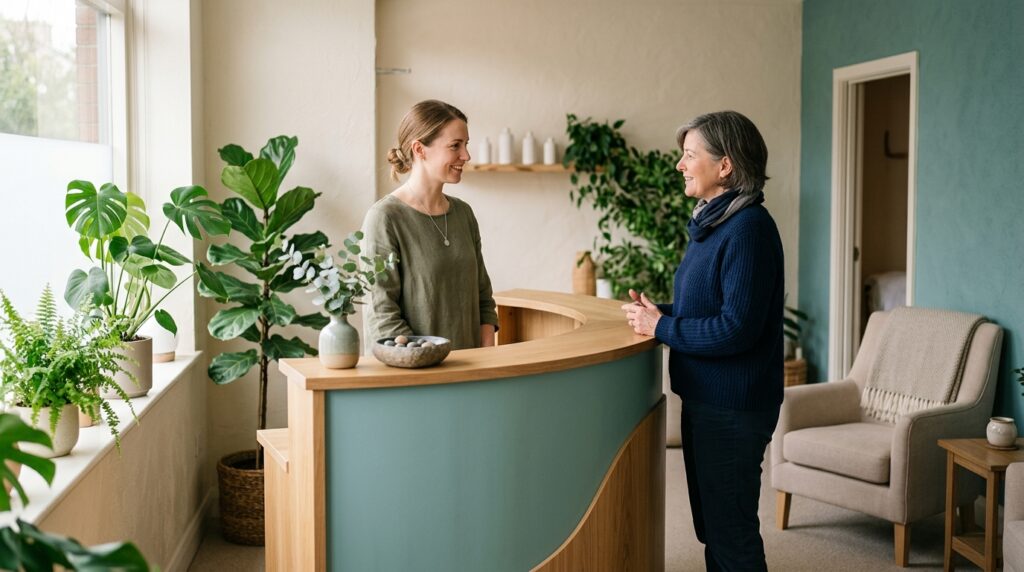
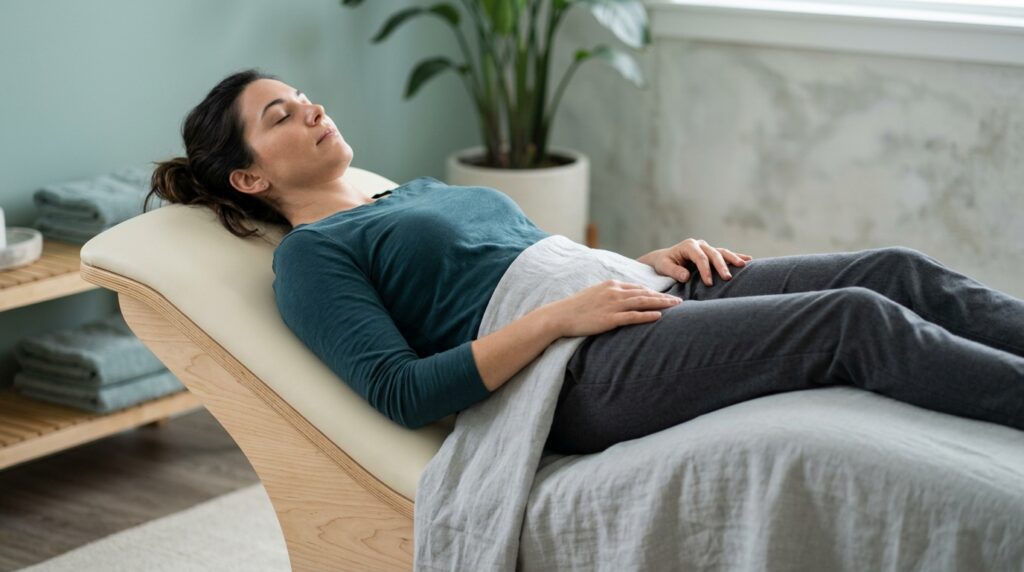
Mobile massage brings convenience but variable setups; Anmowell’s studio offers a consistent, fully clothed Wave, Sonic, and handheld sequence instead.



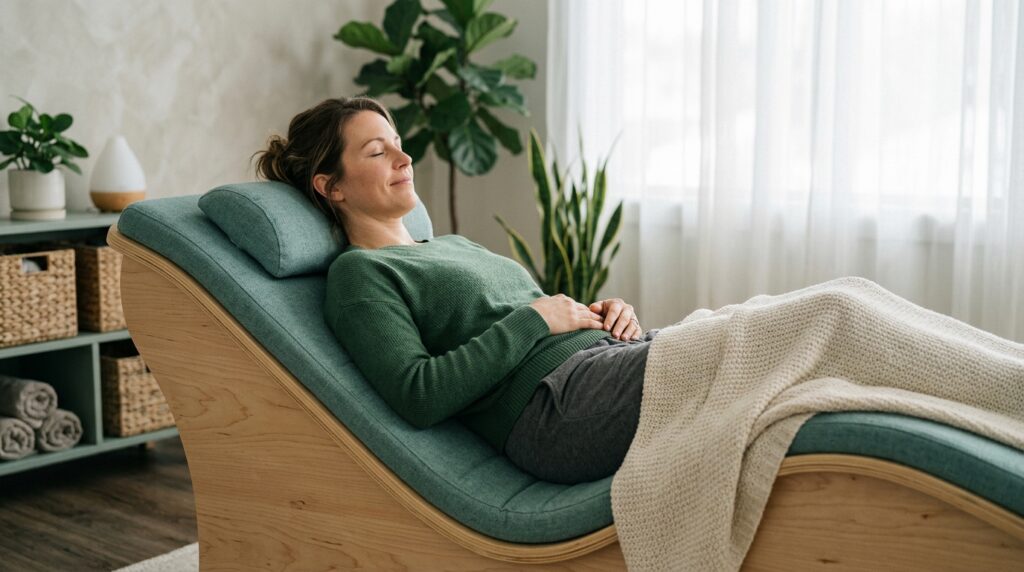



Searching for mobile massage in Fort Lee because you don’t want to fight traffic on Route 4 after a long day? Fair enough. But bringing a therapist to your living room isn’t the only path to real relief, and it comes with its own trade-offs in equipment, space, and consistency. This article breaks down how Anmowell’s in-studio Wave Table, Sonic Table, and handheld sessions stack up against mobile massage for Fort Lee clients weighing their options in 2026.
Here’s the basic model. You open an app or call a booking line, pick a time, and a licensed therapist drives to you with a portable table, sheets and oil in tow. It works for a hotel room in the city, a desk-bound office worker who can’t leave for an hour, or a birthday party where six people want shoulders worked on at once. That’s the whole appeal — the therapist comes to you instead of the other way around.
But convenience has a cost, and it’s not just the travel fee tacked onto your invoice. Equipment varies wildly between providers. One therapist might carry a sturdy, well-padded table; another shows up with something thinner that barely survives the trip. Training and technique vary too, since you’re often matched with whoever’s available nearby rather than someone you’ve vetted yourself. The room itself is whatever you’ve got — a cramped living room, a hotel suite with thin walls, an office break room with people walking past. None of that is under the provider’s control. That’s the trade-off worth knowing before you book.
A studio built around wave and sonic table therapy flips the equation. You travel instead of the therapist, but what you get in return is a space designed for one purpose, with equipment that doesn’t need to be folded into a trunk. If you’re curious how that session actually unfolds stage by stage, a wave and sonic massage therapy guide lays out what each phase is meant to do. There’s no setup lag, no borrowed furniture, no guessing whether today’s table matches last week’s.
It’s also fully clothed and hands-off in the traditional sense — no oils, no disrobing, nothing to prep before a therapist arrives at your door. For reflexive comfort, especially desk workers and seniors wary of pressure-based work, that’s a meaningful difference. The space stays consistent, the machines stay calibrated, and the environment is built around quiet recovery rather than whatever room happens to be free that day. One thing a mobile visit simply can’t offer: a fixed, climate-controlled, single-purpose room every single time.
Searching for a therapist who comes to you is usually about one thing: time. You don’t want to drive anywhere, sit in traffic, or lose half your lunch break to a commute. That’s a fair ask. Convenience matters, especially for people juggling desk jobs, kids, or a packed Fort Lee schedule. But convenience and quality aren’t always the same thing, and it’s worth knowing what you’re trading away before you book.
At-home bodywork comes with logistics most people don’t think about until they’re mid-session. The therapist is working off a portable table set up on your floor, in whatever room has space. Oils mean sheets, towels, and the occasional stain you’ll notice later. Scheduling windows tend to be wider than a studio’s, meaning you wait around for an arrival time rather than walking into a set appointment. Many providers also tack on a travel fee once you’re outside their service zone, which adds up over repeat visits. None of that is a dealbreaker. But it’s real.
A fixed-location studio solves the same stress and tension goals through a different path. Instead of a therapist arriving with a folding table, you walk into a dedicated room built around Wave Table and Sonic Table therapy, finished with a short handheld massage. It’s not an in-home service, and it doesn’t try to be. If you’re comparing options across the area, broader massage wellness near you bergen county listings can help you weigh what’s actually nearby.
The fully clothed, no-oil format also removes most of the at-home prep headaches outright. There’s no draping to arrange, no oil to towel off, no room to clear beforehand. You lie on a table that’s already set up correctly, in a space built for it, and leave without a single stain to deal with. If you’ve got questions about scheduling or want details before your first visit, reaching out through contact us is the simplest way to get a straight answer.

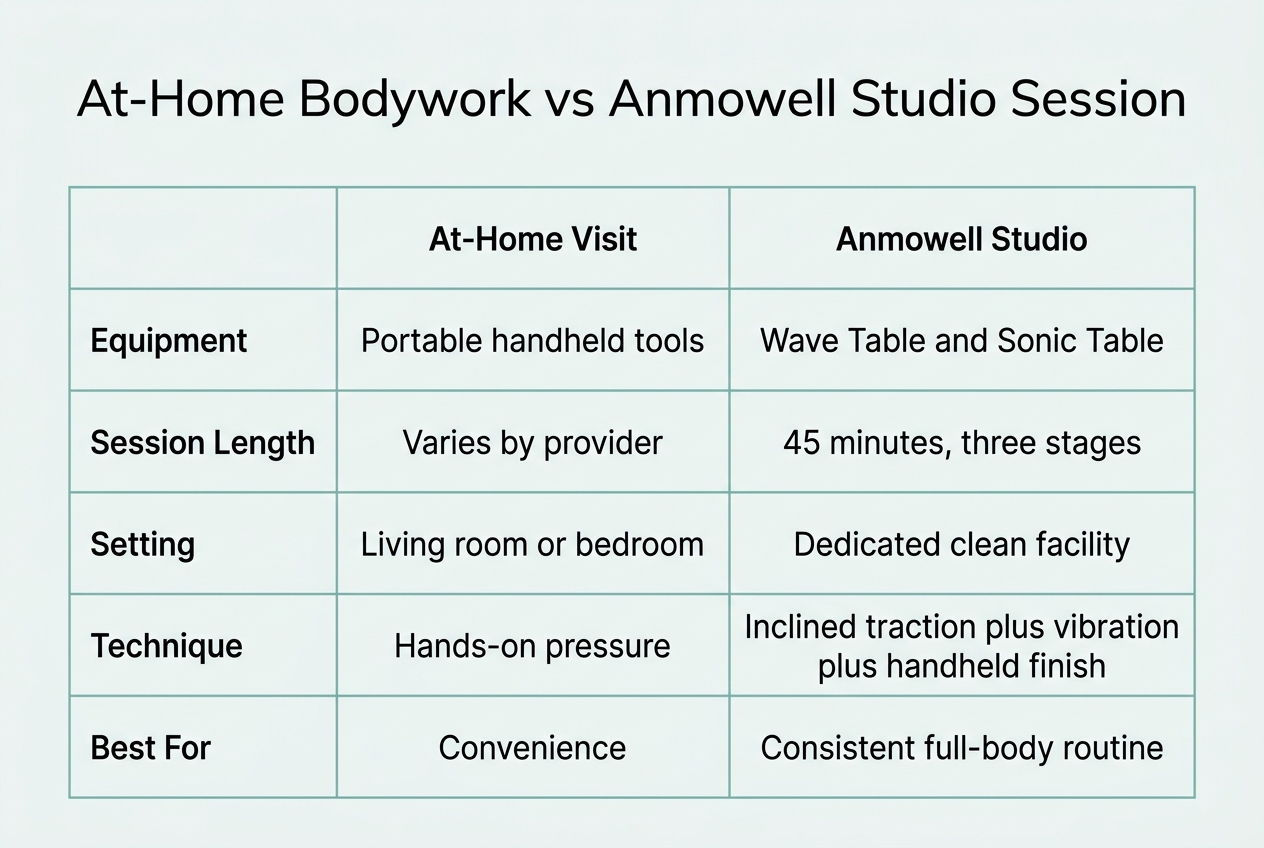
Picking between a therapist who comes to your living room and a fixed three-stage table setup isn’t just about price. It comes down to logistics, how pressure gets applied, and what you’re wearing while it happens. At-home bodywork usually means a hands-on therapist, oils, and a table they set up in your space. A studio session runs on a fixed sequence: incline, vibration, then a short handheld finish, fully clothed, no oils at all. Here’s how the two stack up on the details that actually affect your afternoon.
| Factor | At-Home Mobile Session | Three-Stage Studio Session |
|---|---|---|
| Typical length | 60–90 minutes, travel time extra | 45 minutes total, three stages |
| Pressure style | Hands-on, therapist-controlled | Rhythmic incline plus vibration, adjustable intensity |
| Clothing | Usually undressed, draped with sheets | Fully clothed throughout |
| Setting | Your home, space varies session to session | Dedicated room, same setup every visit |
| Booking window | Often flexible, same-day in some areas | Appointment-based, limited weekly hours |
Neither format wins outright. If you want oils skipped and no disrobing, the studio route is the easier fit. If convenience matters more than consistency, a home visit saves you the drive. One thing worth knowing: vibration and inclined motion are also discussed in circulation research, and massage for better circulation is a useful starting point if that’s your main goal. Either way, check the provider’s cancellation policy before you commit.
The full session runs in three clear stages, and nothing about the order is random. First comes 30 minutes on the Wave Table, a slow, rhythmic inclined motion built to coax the spine into a gentle stretch and ease it back again. You’ll have a heated eye mask over your eyes the whole time, which does more than you’d expect to quiet a busy mind. Intensity is adjustable here, so a first-timer and a regular aren’t getting identical settings.
Next is the Sonic Table, 10 minutes of vibration that starts at the feet and works upward. It’s a different sensation entirely from the Wave stage — less about stretch, more about waking up circulation and muscle tone from the ground up. For anyone dealing with tight calves or sluggish legs after a long day standing or sitting, this is where that gets addressed. If you’re also hunting for pain relief elsewhere in the body, it helps to first read up on massage for neck and shoulder pain and how vibration-based approaches fit into that picture.
The last five minutes bring a handheld massage focused on the back and shoulders, wherever tension is still hanging on. It’s short on purpose — a finishing touch, not a full treatment. Then it’s tea, served warm, while you ease back into the day. Simple close to a simple format.
Some people just don’t want hands pressing into muscle, and that’s fair. No oils, no disrobing, fully clothed start to finish — this format was built around that preference, not around working past it. Anyone who’s dreaded a firm hands-on massage, or sat through one gritting their teeth, will notice the difference immediately. There’s no deep-tissue pressure here, and no attempt to mimic it; the two approaches solve relaxation in genuinely different ways.
That same gentleness is what makes the session workable across a wider age range, including seniors and children, where more aggressive bodywork might feel like too much. The services page lays out how the three stages combine, in case you want the fuller breakdown before booking. Adjustability matters a lot here too — turning intensity up or down on the Wave Table and handheld stage means the same format can feel restorative for a first-timer and still satisfying for someone who’s been coming for months.
None of this replaces clinical care, and it was never meant to. If you’ve got a medical condition, recent injury, or anything currently under a doctor’s care, ask first. That’s not a formality. It’s the honest answer.
Forget the spa-brochure language for a second. Most people walk in with one of a handful of ordinary complaints, not some exotic ailment. A wave-and-sonic table session is built around these recurring, real-life issues rather than abstract relaxation.
None of this replaces clinical care. But for the everyday aches that come from ordinary living, it covers a lot of ground, and comparing pricing across a few session formats helps you decide where to start.
People searching for massage in Fort Lee often type in a style name without knowing exactly what it means. That’s fair. Let’s sort out what overlaps and what doesn’t, starting with the hands-on techniques you won’t find at a wave and sonic table studio.
Thai massage relies on a practitioner physically stretching your limbs and body through assisted positions. A Wave Table does something related but different: it moves you through a passive inclined traction pattern while you lie still. No hands pull or press. This studio does not offer Thai massage, so if assisted stretching is what you want, look for a Thai bodywork specialist instead. Swedish massage is the classic hands-on relaxation session most people picture first. The 45-minute combined Wave and Sonic session is built as a no-disrobing, no-hands-on alternative for that same relaxed, unwound feeling. Deep tissue massage uses firm, targeted hand pressure to work into muscle layers. Sonic Table vibration is not that, and it shouldn’t be mistaken for it. Sports massage is hands-on recovery work tied to training cycles; the Sonic Table can fill a between-training recovery slot, but it’s never sports massage. Trigger point therapy hunts down a single knot with sustained pressure. These tables don’t target points at all — think general muscle relaxation, not pinpoint work. Chair massage is a fast, seated, clothed session, often ten minutes; the full 45-minute session works well as a longer lunch-break alternative instead.
Here’s a quick spec comparison for the equipment-based methods people confuse with this studio’s tables.
| Technique | How it works | Setting | Offered here? |
|---|---|---|---|
| Acoustic wave (shockwave) therapy | Focused acoustic pulses aimed at tissue | Clinical / medical office | No |
| Hydromassage | Water jets beneath a vinyl bed surface | Spa or gym recovery room | No — dry mechanical tables only |
| Lymphatic drainage (MLD) | Trained hands guide fluid along lymph pathways | Clinical or licensed therapist setting | No — vibration supports circulation, doesn’t drain lymph |
| Sonic Table Therapy | Whole-body mechanical vibration, feet upward | Studio, fully clothed | Yes |
Vibration and shockwave are often lumped together; they’re not the same technology at all. Building a massage self care routine around the right tool matters more than chasing a trendy name, and knowing what you’re actually signing up for saves a wasted trip.
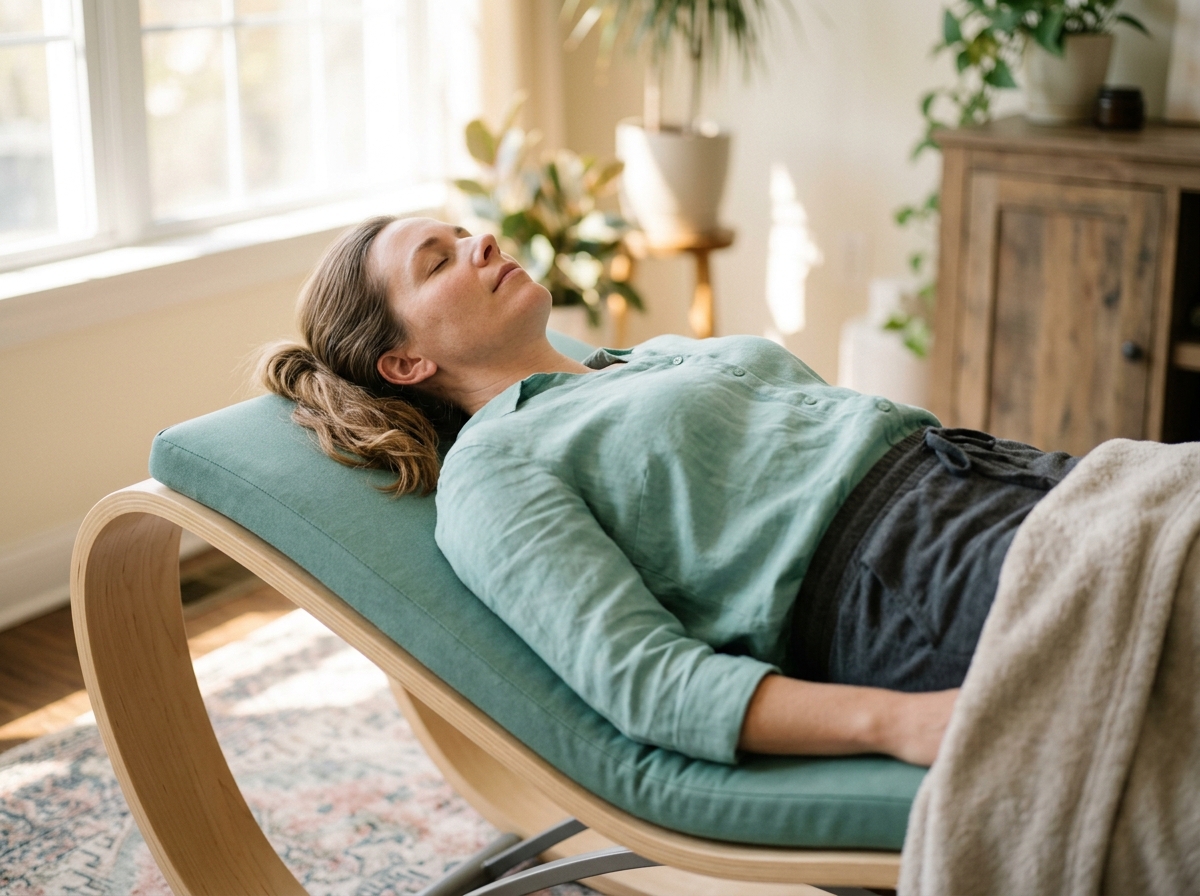
Gentle, fully clothed and oil-free doesn’t mean risk-free for everyone. Vibration and inclined traction move the body in specific ways, and some conditions call for a doctor’s sign-off before you book. This isn’t about scaring anyone off. It’s about being honest so you can make the right call.
Guests who are pregnant are asked to check with their doctor before booking, and the tables aren’t offered during pregnancy at all. If pregnancy-safe bodywork is what you need, a licensed prenatal massage therapist trained in that specific positioning and pressure is the right choice, not a wave or sonic table. The same caution carries into the early postpartum period. That stretch of weeks after delivery is treated the same as pregnancy itself: ask a doctor first. This should never be mistaken for postpartum recovery care.
Beyond pregnancy, a short list of medical conditions means a conversation with your doctor comes before any booking. Local demand for low-impact recovery options is real, and plenty of people search for vibration therapy near me fort lee without realizing these screening questions apply. Here’s who should pause and check first:
Handheld massage has its own simple rule: it’s skipped over open wounds, rashes, bruises, recent injuries, and any spot with a known clot. None of this is medical advice, and it’s never a stand-in for clinician-led medical massage or physical therapy. When in doubt, ask your doctor before you book.
If you’re new, the easiest way in is the $38 introductory session. It’s a low-stakes way to see whether the Wave and Sonic format actually does something for your back before you commit to anything bigger. The studio sits at 2460 Lemoine Ave, Suite 501, Fort Lee, NJ 07024, with free parking on site — no circling the block hunting for a spot. Calling ahead at (201) 429-2265 is worth doing since appointments fill up.
Beyond that first visit, you’ve got single sessions, a 4-session bundle, a 10-session bundle, and a monthly unlimited membership. The bundles make sense if you already know you want ongoing relief rather than a one-off reset, and unlimited membership suits anyone trying to build a weekly habit around desk-job stiffness or training recovery. Staff speak English, Mandarin, and Cantonese, which matters for a lot of Bergen County households juggling multiple languages at home.
Hours run Friday and Saturday 10 AM to 9 PM, Sunday 2 PM to 8 PM, with Monday and Thursday by appointment only. Tuesday and Wednesday, the studio’s closed. There’s a 24-hour cancellation notice policy, so plan your week before you book. Clients come from Fort Lee, Cliffside Park, Palisades Park, Edgewater, Leonia, Englewood, and the wider Bergen County area, which tells you the limited hours are worth working around.
Since opening in October 2025, the studio has racked up a 100% five-star rating across 142 Google reviews. That’s a small sample compared to decades-old spas, but it’s a clean, consistent record. Reviewers keep circling back to the same handful of things: welcoming staff, noticeable back pain relief, a deep stretching sensation during the Wave Table stage, and relief from neck pain after sessions. A clean, calm facility comes up often too.
The back pain and stretch comments line up with what the Wave Table is built for: a slow, rhythmic incline that decompresses the spine without anyone’s hands on you. For readers who want the research angle rather than just anecdotes, there’s a breakdown of vibration massage back pain relief worth reading before your first visit. Neck pain relief tends to get mentioned by people who spend their day hunched over a laptop — no surprise there.
Repeat clients also bring up the personalized handheld finish more than you’d expect. It seems to be the detail that turns a good session into one people rebook. None of this replaces a doctor’s advice for anyone managing an actual medical condition — it’s relaxation and recovery support, not treatment. But for stiffness, soreness, and bad circulation from sitting too long, the pattern in these reviews is pretty consistent.
So which one wins? It depends what you’re actually after. If convenience is everything and you want hands-on pressure in your own living room, a traveling therapist checks that box. If you want consistency, a dedicated calming space, and a clothed, no-oils routine that doesn’t vary session to session, a studio table setup is the better fit. Mobile work depends on who shows up, their schedule, their technique that day. A fixed location with a repeatable three-stage format removes that guesswork, which is partly why people researching the best massage spa fort lee nj has to offer keep landing on studio-based options.
Travel logistics matter more than people expect. A mobile session means clearing space, setting up a table, working around parking and traffic in your building. A studio visit means you drive, park free, and walk into a room already set up for you. First-time pricing at $38 makes it cheap to compare the two directly instead of guessing which suits you. Try one, try the other, see what your body and your schedule actually prefer. That’s a more honest test than reading reviews.
One more thing, regardless of which route you pick: if you’re pregnant, have a pacemaker, recent surgery, or any ongoing condition, talk to your doctor first. Not a suggestion. A requirement. Neither mobile massage nor studio table therapy should be a guessing game with your health.
Choosing between these approaches really comes down to what your body needs and what your doctor allows. Some people want hands-on, targeted work for a specific knot or injury, while others are simply looking for a quiet way to unwind without disrobing or being touched. Whatever you decide, it’s worth asking about the technique itself, any health conditions that might rule it out, and whether the setting feels as calm and welcoming as the relief you’re hoping to find.
Temporary closure
The studio is closed while our team is away. You are welcome to book ahead for after we reopen.
Thank you for your patience. See you soon.