If sitting still for talk therapy feels impossible, sand tray therapy gives your hands something to do while deeper work happens.


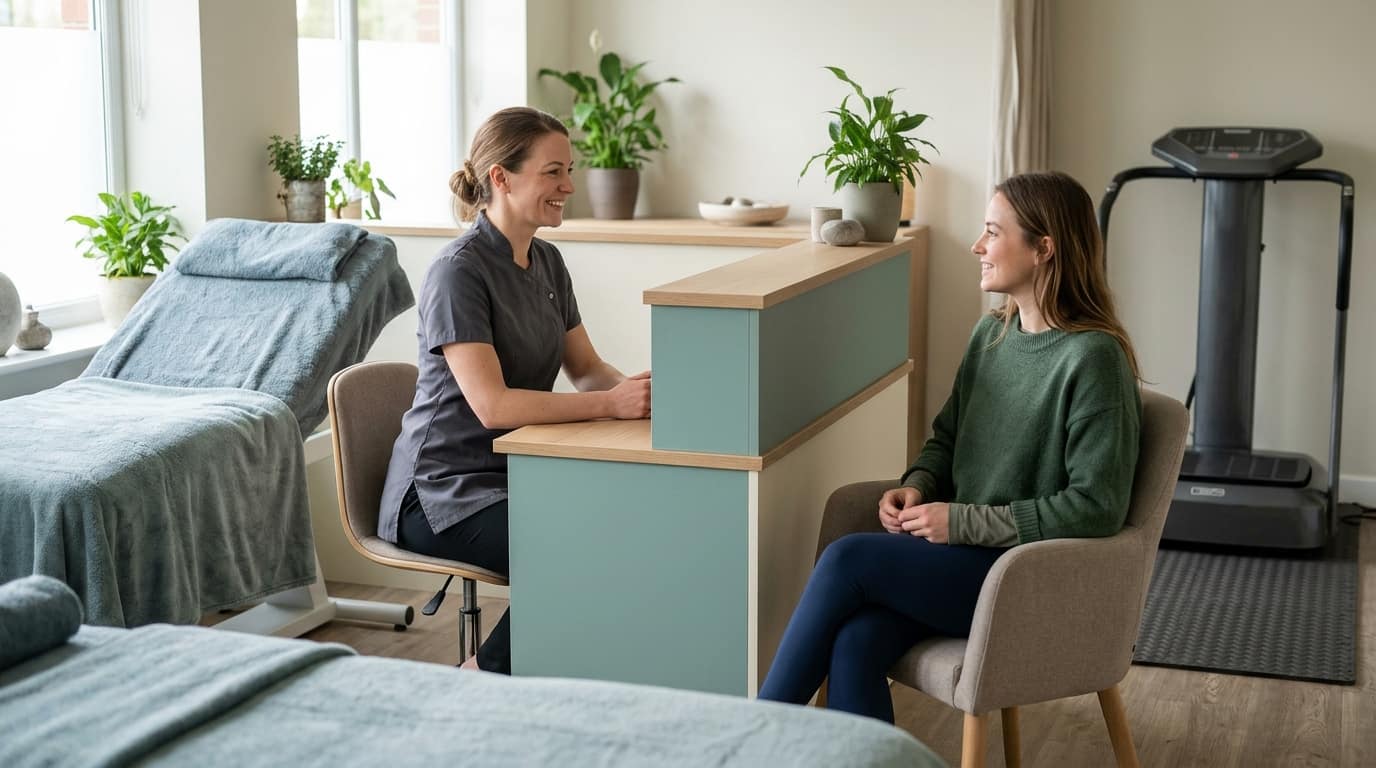
If sitting still for talk therapy feels impossible, sand tray therapy gives your hands something to do while deeper work happens. It’s a quiet, expressive tool many counselors use alongside body-based relaxation methods. This piece looks at who it helps and how it compares with options that work through the body instead of the mind. At Anmowell, that body-based piece shows up as Sonic Table Therapy, Wave Table Therapy, and Handheld Massage — tools built for tension, not talk.
The setup is simple on purpose. A rectangular tray, usually blue on the inside to suggest water or sky, gets filled with sand that a client can shape, smooth, or dig through with their hands. Nearby sits a shelf, sometimes hundreds of miniature figures deep: animals, people, houses, bridges, fences, even fantasy creatures. The client chooses freely, places objects where they want, and builds a scene without being told what it should mean. No words are required. That’s the whole point.
This isn’t a wellness practice in the way a massage or a stretching session is. It’s a psychotherapeutic method built to let feelings surface nonverbally, especially ones a person can’t yet name out loud. The tray becomes a kind of sentence, and the figures are its words. Someone might bury a small figure under sand, or keep two animals facing away from each other at opposite corners. None of that is accidental once a trained eye starts looking at it.
A trained therapist doesn’t hand over a tray and step away. They watch closely: which figures get picked up first, where objects land, how much sand gets moved, whether the scene changes halfway through. They’re tracking themes across sessions, not judging a single picture. A child who repeatedly isolates one figure in the corner of the tray might be working through something about exclusion or fear, and the therapist’s job is to notice the pattern and, when appropriate, gently ask about it.
This process sits squarely in talk therapy and play therapy traditions, not bodywork. It targets emotional and psychological processing, not muscle tension or circulation. That distinction matters if you’re trying to decide what kind of support fits what you’re dealing with right now. If your shoulders ache from twelve hours a week hunched over a laptop, a tray of sand won’t touch that; it was never built to. Separately, anyone exploring non-contact tools for muscle recovery might come across soft wave therapy and how it works, which operates on an entirely different principle than sand tray work, using acoustic energy rather than symbolic play. Both are legitimate, but they’re solving different problems for different parts of a person. Worth noting here: Anmowell doesn’t offer acoustic or shock wave therapy of any kind — its tables run on whole-body vibration and inclined traction instead.
The story starts in London in the 1920s with Margaret Lowenfeld, a pediatrician who noticed something odd: children given a tray of sand and small figures didn’t just play. They built scenes that told you something true about what was going on inside them. She called it the “World Technique,” and she wasn’t trying to interpret symbols through an adult’s lens. She just watched what kids made, and let the tray do the talking.
Dora Kalff, a Swiss analyst trained in Jungian thought, took that raw observational tool and gave it a deeper psychological frame in the 1950s. She studied under Carl Jung himself and folded in his ideas about archetypes and the unconscious. The result, which she named sandplay, treated the tray as a kind of mirror for the psyche. Kalff believed a client’s inner world, conflicts included, could surface and reorganize itself through the simple act of arranging figures in sand. That belief still shapes how practitioners approach the method today.
Between Lowenfeld’s clinical curiosity and Kalff’s analytic depth, the method found its two legs: one rooted in observation, one in interpretation. Both still matter. Neither fully replaced the other.
For decades, sand tray work stayed mostly in the pediatric lane, used by clinicians who needed a way to reach children too young, or too guarded, to talk about feelings directly. Through the 1960s and 70s, child psychologists across Europe and the United States folded it into broader developmental and play-based assessment practices. It gave quiet kids a voice without demanding words.
By the 1980s and 90s, therapists started noticing the same tray worked for adults, too. Trauma specialists, grief counselors, and family therapists began using it with clients who felt stuck in verbal talk therapy. Couples and family sessions sometimes used a shared tray, watching who reached for which figures first. That’s often more revealing than an hour of conversation.
As expressive arts therapy grew into its own recognized field, sand tray work found good company alongside art therapy, drama therapy, and movement-based approaches. All of them share a core premise: insight doesn’t always need language. Professional associations formed, training standards tightened, and by the early 2000s it had become a standard offering in many child and family counseling practices nationwide.
That expressive-arts lineage also explains why the method sits comfortably next to body-based relaxation work today. Both traditions trust the body and hands over pure talk. If you’re researching options in Bergen County, it’s worth noting that providers offering vibration therapy near Fort Lee are addressing physical tension specifically, not emotional processing, a distinction worth keeping straight as these fields increasingly get mentioned in the same breath. Interest in integrative, whole-person wellness has only grown since, the same cultural shift that’s fueled adjacent conversations around things like regular skincare routines and other maintenance-based self-care habits.
Age changes almost everything about a session, except the tray and the shelf of miniatures. A 6-year-old and a 60-year-old might use the exact same figures and still be working on completely different problems. What stays constant is the idea that hands can say what a mouth can’t. What shifts is the goal underneath it.
For children, the tray is often a way to process trauma, anxiety, or family changes like divorce or a new sibling, without forcing them to narrate it out loud. A child who can’t explain why they’re angry might build two houses far apart, with a tiny figure stuck between them. That’s the work. Adolescents use the same tools differently, usually to sort out identity, peer conflict, and emotional regulation, often resisting the “childish” label until they realize no one’s asking them to explain themselves. Adults tend to come in for grief, trauma processing, or simply because words have stopped working. A therapist I’d call direct about this once put it bluntly: talk therapy hits a wall sometimes, and that’s not failure, it’s just a different door.
The table below is a rough guide, not a rulebook. Plenty of overlap exists between groups.
| Age Group | Primary Focus | Typical Session Length | Common Material Used |
|---|---|---|---|
| Children (4–11) | Trauma, anxiety, family change | 30–45 minutes | Animals, family figures, houses |
| Adolescents (12–17) | Identity, peer conflict, regulation | 45 minutes | Symbolic objects, fantasy figures |
| Adults (18+) | Grief, trauma, subconscious material | 45–60 minutes | Abstract objects, personal items |
| Older adults | Life review, loss processing | 45 minutes | Nature elements, memory-linked figures |
None of this overlaps with body-based relaxation work, and it shouldn’t. A provider offering Wave Table or Sonic Table sessions is addressing physical tension, not emotional history, and won’t claim otherwise. If you’re weighing talk-based or play-based emotional processing against a physical reset, it helps to understand how a wave and sonic massage therapy session actually works before deciding which one fits the week you’re having, or whether you need both.
This approach shows up well beyond a therapist’s private office. School counselors use it with kids who can’t yet put a conflict into words, watching where a child places the fence, the dragon, or the lone figure in the corner. Family therapists bring it into sessions where several people build one shared tray together, and the arrangement itself often says more than an hour of talking would. It’s also moved onto screens, which raises its own set of questions.
In person, a counselor can watch a child’s hands hesitate before a figure goes down. That timing detail often gets lost on video. Telehealth has adapted with at-home kits shipped to the client, or with virtual sand tray software where figures are dragged and dropped on a screen. Neither replaces touch and placement entirely, but for families spread across cities, or teens who won’t speak but will build, it keeps the work going.
If you’re considering remote sessions, ask a few blunt questions first. Does the provider have specific training in sand tray or expressive play methods, not just general telehealth experience? How do they handle a child who gets distracted or walks off camera? For a broader sense of how vibration and sound-based approaches get adapted for remote or home use, a vibroacoustic therapy guide covers some of the same access tradeoffs. Honestly, if a child needs to feel the sand, no app fully replaces that.
It helps to see where sand tray actually sits next to the other things people lump together as “therapy.” Cognitive Behavioral Therapy (CBT) is structured and verbal — you name a thought, challenge it, and track progress with homework and worksheets. Sand tray works the opposite way. There’s no script. A client arranges miniature figures in sand, and meaning surfaces symbolically, often without a single word about what it “means.” Neither replaces the other; they just reach different material.
Other expressive arts therapies sit closer to sand tray on that spectrum. Art therapy and music therapy are also nonverbal and symbolic, and many clinicians treat them as complementary tools within the same session plan rather than competing methods. Then there’s a third category entirely: body-based relaxation. This doesn’t touch psychological processing at all — it targets physical tension, circulation, and nervous-system calm. The table below lays out the contrast plainly.
| Approach | Primary Mode | What It Targets | Typical Session Length |
|---|---|---|---|
| CBT | Verbal, structured | Thought patterns, behavior change | 45–60 minutes |
| Sand Tray Therapy | Nonverbal, symbolic | Emotional processing, trauma expression | 30–50 minutes |
| Art / Music Therapy | Nonverbal, expressive | Emotional release, communication | 45–60 minutes |
| Body-Based Relaxation (e.g. Wave and Sonic Table sessions) | Physical, passive | Muscle tension, circulation, stress response | 10–45 minutes |
That last row matters. A body-based session won’t help someone process grief symbolically, and sand tray won’t loosen a stiff lower back. If you’re weighing options, understanding whole body vibration therapy benefits is a reasonable starting point for the physical side of that equation, while the psychological side stays squarely in a therapist’s office. Different tools, different jobs. Don’t expect one to cover for the other.
Sand tray work is built for feelings you can’t put into words yet. It’s not built for a stiff neck from eight hours at a desk, tight hamstrings after a long run, or hands that go cold because circulation is sluggish. Those are physical patterns, plain and simple. No amount of arranging figures in sand will loosen a locked-up lower back. That’s a different job, and it calls for a different tool entirely.
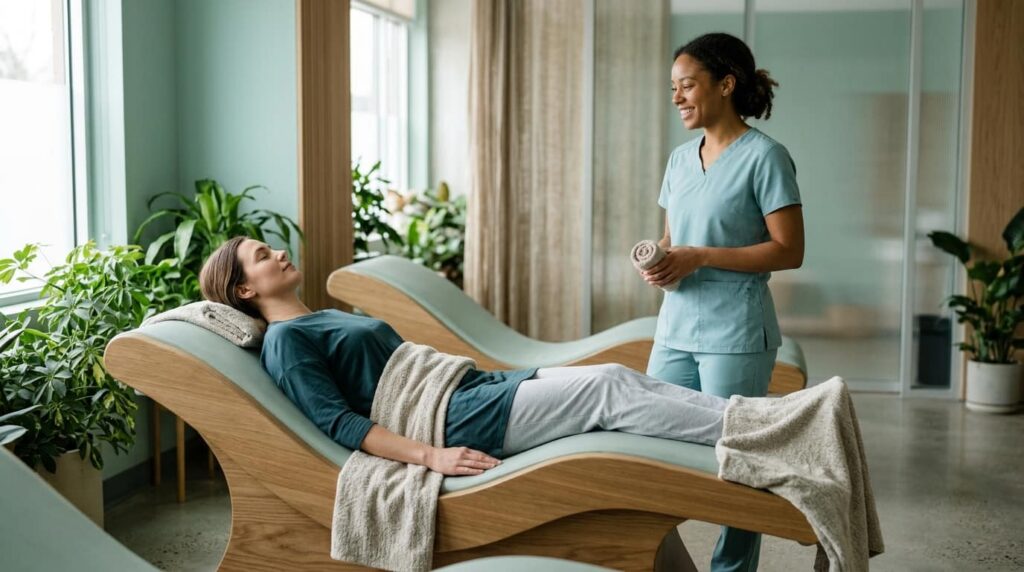
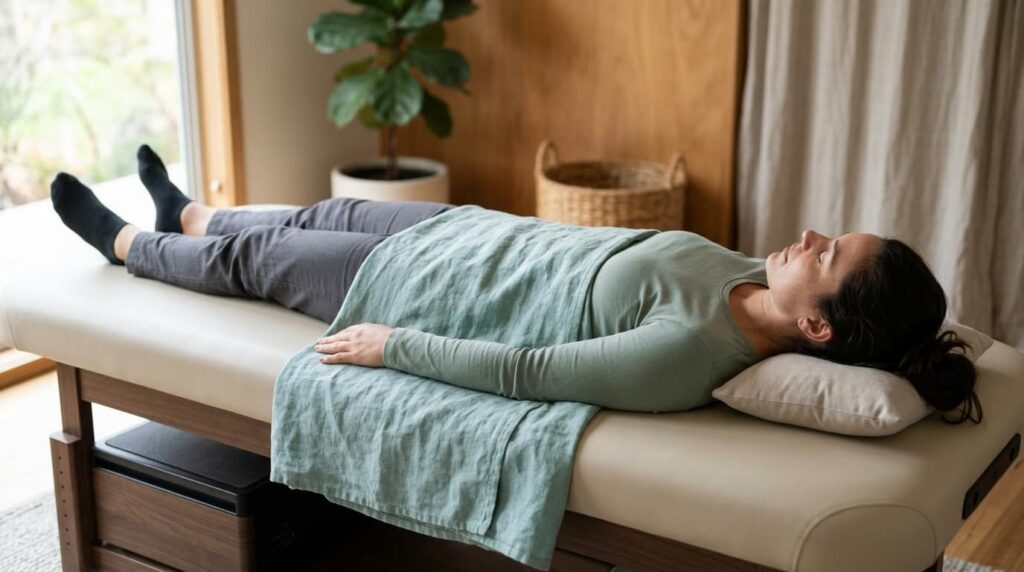
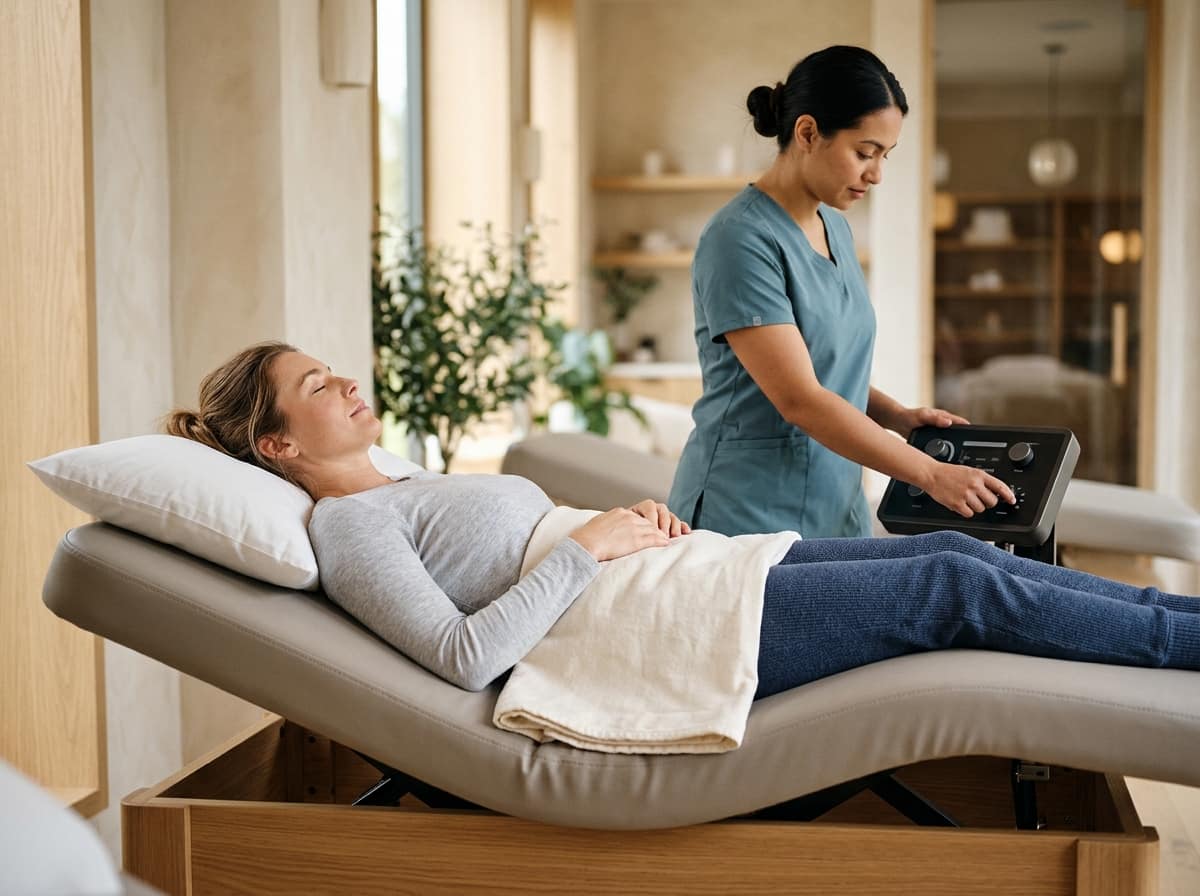
Wave Table Therapy approaches that job through motion, not talk. The session uses a gentle rhythmic inclined table to create spinal traction over about 30 minutes, with intensity you can adjust as you go and a heated eye mask to help you settle in. People researching massage for neck and shoulder pain often land here because it offers that kind of relief without hands-on pressure and without lying face-down for an hour. Welcoming staff and relief from neck and back pain are two things guests mention most often after a session.
Sonic Table Therapy picks up where that leaves off, running vibration from the feet upward for about ten minutes. It’s meant to ease general muscle tightness and support circulation. It is not sports massage, and it’s not aimed at a specific training injury the way a sports massage therapist’s work would be. Think of it instead as a between-training recovery option, something you’d add to your week rather than a clinical fix.
Then comes the handheld massage, a short five-minute finish focused on the back and shoulders. This is where lingering tension that didn’t fully release during the first two stages gets some direct, personalized attention. It’s brief by design. This isn’t deep tissue work, and it doesn’t target a single knot the way trigger point therapy does — it’s general muscle relaxation, a wind-down before you walk back out into your day.
All of it happens fully clothed, with no oils and no deep pressure, which makes it a comfortable option for people who find traditional massage too intense or too intimate. Guests often describe the staff as informative, and stretching comes up again and again as part of what people value about the Wave Table in particular. Still, it’s worth saying plainly: this is a body-focused alternative, never a substitute for psychological therapy. If what you’re carrying is emotional rather than muscular, a trained therapist is the right call, not a table.
Sand tray work is talk and symbol based, so it rarely carries physical risk. Body-based relaxation is different. Any session involving tables, vibration, or incline needs a real safety check first, not a quick glance at a brochure. Before booking something like a wave table or whole-body vibration session, it’s worth knowing who should pause and call a doctor instead of just showing up.
Pregnancy is the clearest line. Anmowell asks guests who are pregnant or trying to conceive to check with their doctor before booking, and does not offer Sonic Table or Wave Table sessions during pregnancy — a licensed prenatal massage therapist is the appropriate choice there, full stop, no exceptions made for “just a gentle setting.” The same caution applies in early postpartum weeks: that’s a question for your doctor, not a studio’s front desk, and Anmowell does not position its tables as a recovery option after delivery. Beyond pregnancy, several other conditions call for medical clearance before either table is used. These include:
Handheld massage carries its own simple rule: it’s skipped over open wounds, rashes, bruises, or any area with a known blood clot, and it isn’t offered as a standalone for guests who can’t use the tables in the first place. None of this is medical advice. Anmowell asks any guest with a medical condition, recent injury, or ongoing treatment to check with their doctor before booking — and separately, understanding massage for better circulation can help you ask sharper questions at that appointment.
If what you’re dealing with is emotional — grief, trauma, anxiety that won’t let up — the sand tray belongs in a therapist’s office, not a relaxation studio. Credentials matter here. Ask whether the provider is a licensed therapist or counselor, and whether they’ve had actual training in sand tray or play therapy specifically, not just a passing exposure in grad school. Also ask how a session is structured: do you talk through the scene you’ve built, or is the process itself the point? A good provider will answer all of this without hesitation.
Different goal, different questions. If you’re after physical ease — a tight back, restless sleep, legs that ache after a long run — you’re shopping for comfort and logistics, not clinical credentials. Ask about session length, whether intensity can be adjusted to your comfort, and what conditions might rule the session out. Pregnancy, pacemakers, recent surgery, and a few other conditions are standard contraindications across most vibration and inclined-table setups, so a studio that brings this up unprompted is one worth trusting.
Booking logistics matter too, especially if you’re juggling a work schedule or coming from across Bergen County. One local studio in Fort Lee offers single sessions, 4- and 10-session bundles, and a monthly unlimited membership, with a $38 introductory session for new clients who want to test the waters before committing. Free parking, staff who speak English, Mandarin, and Cantonese, and a clear 24-hour cancellation policy all make planning simpler. For readers comparing options nearby, massage wellness near you bergen county is a reasonable starting point for seeing what’s available beyond hands-on massage. Just know that appointment-based studios with limited weekly hours fill up fast — booking a few days ahead beats showing up and hoping for an opening.
Sand tray therapy works through a different channel entirely, using symbols and imagery in a quiet, therapist-led setting to help process emotion, so it isn’t something to compare directly against a wellness table. If what drew you to the idea was the sense of a calm, sensory space to decompress, that’s worth sitting with on its own terms, and if it was more about easing physical tension in your back or neck, Anmowell’s Wave Table Therapy offers a different kind of session built around that instead. From here, it’s simply a matter of being honest about what you’re actually seeking relief from, and choosing the path built for it.