

What postpartum massage therapy is, who is licensed to provide it, warning signs that need a clinician, and why your doctor or midwife decides when.

What postpartum massage therapy is, who is licensed to provide it, warning signs that need a clinician, and why your doctor or midwife decides when.
If you searched for postpartum massage therapy, you are probably somewhere in the first weeks or months after giving birth, sore in places nobody warned you about, and wondering whether bodywork is even allowed yet. That is a fair question. It deserves a straight answer rather than a sales page.
This article explains what postpartum massage therapy actually is, who is trained and licensed to provide it, what new parents commonly hope it will do, and why the one question everyone wants answered, which is when it is safe to start, belongs to your own doctor or midwife and to nobody else. It also states plainly what Anmowell, a wellness studio in Fort Lee, does and does not offer, so you are not left guessing.
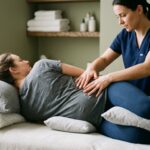
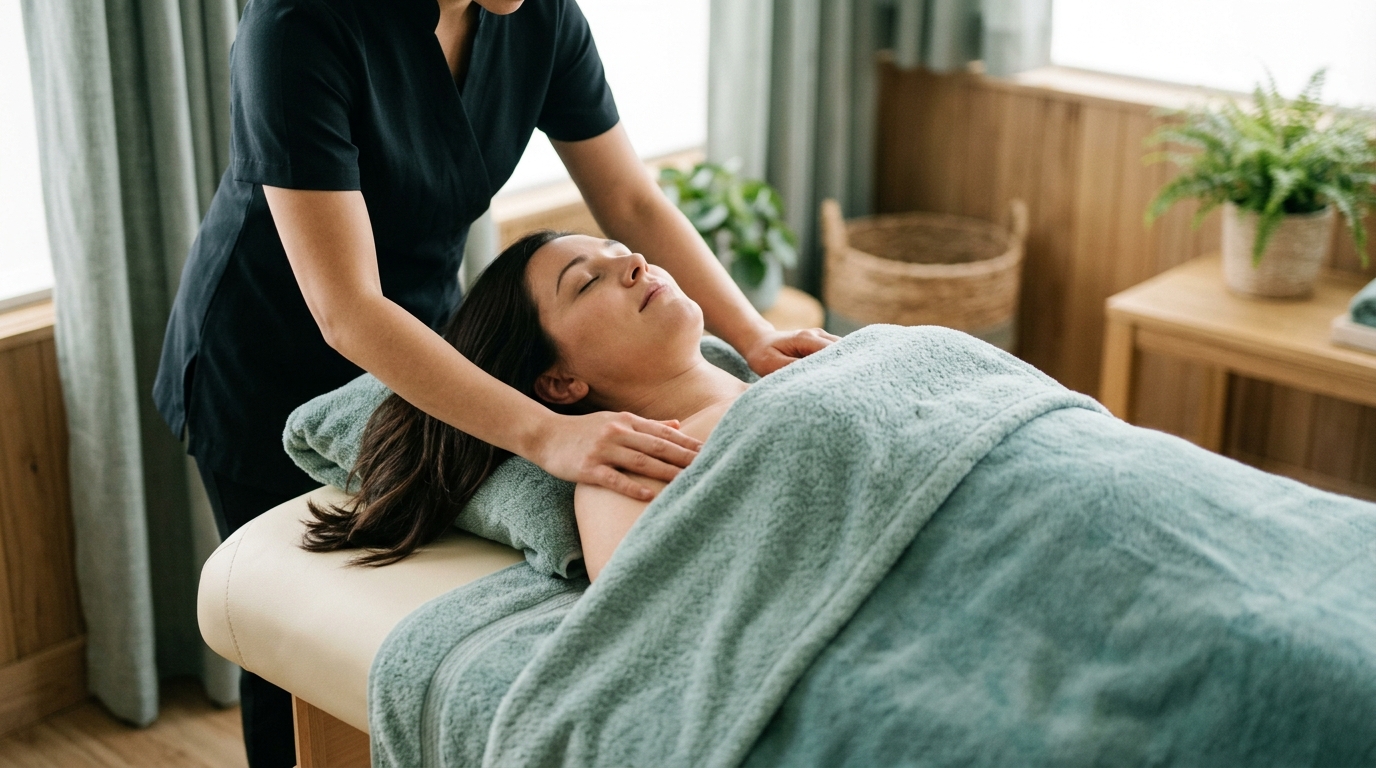
Postpartum massage therapy is hands-on soft tissue work performed by a trained, licensed massage therapist in the period after birth. In practice it usually means a therapist adapting an ordinary massage to a body that is still recovering. That can look like side-lying positions propped with pillows instead of long stretches face down, slower and lighter pressure over areas that are still tender, attention to the neck, shoulders, upper back and hips, and real care taken around the abdomen. Therapists with extra training may also work on cesarean scar tissue once an incision has fully healed, or use lymphatic techniques when swelling is the main complaint and a clinician has ruled out causes that need medical attention.
The word postpartum in front of the word massage does not describe a machine or a proprietary method. It describes a therapist who has been trained to account for what a body has just been through, and who will ask about your delivery, your bleeding, your incision if you had one, your blood pressure and your feeding routine before putting hands on you. That intake conversation is the substance of the thing. A practitioner who does not ask is not doing postpartum work, whatever the website says.
The differences are mostly practical. Positioning changes, because lying face down on a full chest is uncomfortable for many people who are nursing and impossible for some. Pressure changes, because tissue that is still knitting itself back together does not respond to force the way it did a year ago. Timing changes, because sessions often get built around a feeding window rather than around a standard hour. And the exit changes, because a good therapist will say at the start that you can stop, shift, sit up or feed at any point without explaining yourself.
It is not treatment for a medical complication. It is not a replacement for your postpartum check. It is not a way to make healing happen faster, and it is not pelvic floor rehabilitation, which is a separate discipline with its own training. Be wary of any page promising that massage will close abdominal separation, flatten a stomach or fix a pelvic floor. Those claims are marketing, and they tend to turn up on the same pages that skip the intake questions.
Most people who go looking for postpartum bodywork are not chasing a cure. They are carrying a specific and very recognizable set of aches, and they want an hour where somebody pays attention to their body instead of the baby’s. The common reasons cluster tightly:
It is worth keeping expectations the right size. The research on massage in the postpartum period is limited and mixed, and most of what it points to is short-term comfort rather than structural change. Relief from a good session is usually real and usually temporary. That is not a reason to skip it. It is a reason to treat it as comfort care, and to be suspicious of anyone selling it as recovery itself.
Some of what shows up after birth is not muscle tension, and it should not be taken to a massage table while you wait and see. Contact your doctor or midwife promptly, or seek emergency care, if you notice any of the following:
None of that is a reason for embarrassment and none of it is too small to call about. Clinicians would far rather hear from you at eleven at night than read about it later.
You will find pages that hand you a number of weeks. This article will not, and no wellness studio should either. The reason is simple. Whether a particular body is ready for hands-on work depends on how the birth went, whether there was a cesarean or a tear and how it is healing, how the bleeding has changed, blood pressure, anemia, clotting history, medication, and a dozen other things that live in your chart rather than on a web page. Someone who has never met you cannot know any of that, and a business that earns money from your appointment is the last party who should be setting the date.
Your obstetrician, midwife or primary care clinician can. They know the delivery, they can look at the incision, and they can tell you not only whether to start but what to avoid and for how long. Ask them directly. Clearance is usually a two-minute conversation at a check-up or a message through a patient portal, and it turns a guess into an answer.
One more thing is worth saying out loud. Clearance is not permanent and it is not universal. Being cleared for gentle massage is not the same as being cleared for deep pressure, for whole body vibration, for mechanical traction, for a sauna or for exercise. If the answer you were given was about one thing, ask again before you assume it covers another.
Bring the specifics. The more precisely you describe what you are considering, the more useful the answer will be.
If and when your clinician has given you an answer, the next filter is the practitioner. These questions sort a trained postpartum therapist from a general practice that added the word to a service menu.
A practitioner who welcomes those questions is telling you something useful. So is one who brushes them off.
Postpartum bodywork sits among several different professions, and the right one depends on what is actually bothering you. Licensed massage therapists, some of them with additional perinatal certification, do the hands-on soft tissue work described above. New Jersey licenses massage and bodywork therapists at state level, so a license is something you can ask about and check rather than take on trust. Pelvic floor physical therapists are the people to see for leaking, heaviness, pain with intercourse, abdominal separation, or pain that is more structural than muscular, and a referral from your clinician often speeds that up. Lactation consultants handle feeding mechanics, which is often part of the picture when shoulder and neck pain will not settle. Your obstetrician or midwife stays at the center of all of it, because they are the one who decides whether and when any of it starts.
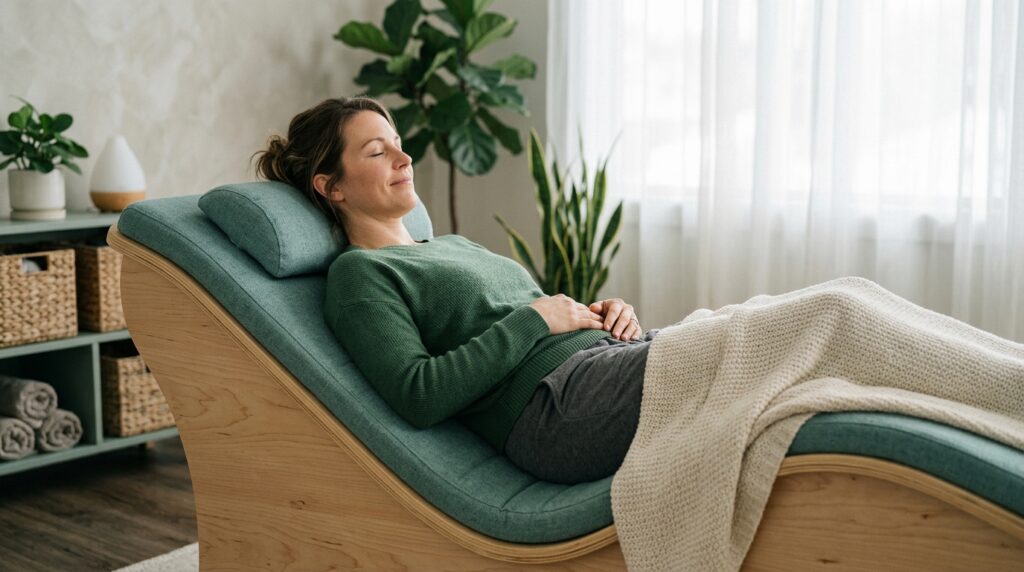
Anmowell is an appointment-based wellness studio in Fort Lee, and it offers exactly three things. Wave Table Therapy is 30 minutes on a rhythmic inclined table that produces passive spinal traction, with the guest fully clothed. Sonic Table Therapy is 10 minutes of whole body vibration delivered from the feet upward. The third is a 5 minute handheld massage of the back and shoulders, which is the short closing stage of a session rather than a treatment in its own right.
Anmowell does not offer postpartum massage therapy. It does not offer prenatal massage, Swedish, deep tissue, sports, lymphatic drainage, myofascial, trigger point, cupping, acupressure, Thai or medical massage, it has no licensed massage therapists on staff for that kind of work, and nothing on its menu is a substitute for the care this article describes. Whole body vibration and inclined mechanical traction are both generally listed as contraindicated during pregnancy, so the studio does not put pregnant guests on the tables, and anyone who has been pregnant recently is asked to speak with their own doctor or midwife first. Anmowell does not give medical advice and does not decide when a recovering body is ready. That decision belongs to your clinician, which is exactly where it should sit.
Local results for postpartum massage in this corner of Bergen County mix several different things together. Day spas, wellness studios, chiropractic offices, physical therapy clinics and independent mobile therapists all surface in the same list, and the pages tend to read alike. The word postpartum on a website is copy until somebody shows you a credential behind it, and a business listing a service tells you what it sells, not whether it suits your situation or your timing.
Which is why the search results are the last step rather than the first. The order that works is a clear answer from your own clinician about your own body, and then, only if that answer is yes, a look at who is licensed and trained for what you actually need. At that second stage the questions above are the whole filter: who specifically would be working on you, what that person is licensed to do, and what they want to know about your delivery before they agree to anything. Vagueness on any of those is itself an answer.
Postpartum recovery does not run on a schedule you can read off a web page, and no website can see your chart. The useful order is the boring one. Talk to your doctor or midwife first and get a clear answer about your own body, then choose a practitioner who is licensed and trained for what you actually need and who asks you real questions before they touch you. Whatever any article or any studio tells you about timing, this one included, the only opinion that counts is the one from the clinician who knows how your birth went.
Temporary closure
The studio is closed while our team is away. You are welcome to book ahead for after we reopen.
Thank you for your patience. See you soon.