

Prenatal massage therapy means trained hands adapted to pregnancy; vibrating and tilting tables are machines with pregnancy on their contraindication lists.

Prenatal massage therapy means trained hands adapted to pregnancy; vibrating and tilting tables are machines with pregnancy on their contraindication lists.
Search for prenatal massage and two different things come back wearing the same words. One is hands-on bodywork, given by a therapist with training specific to pregnant bodies. The other is equipment: tables that vibrate, tables that tilt and rock, chairs that knead. Both get described as gentle, soothing and non-invasive, and that shared vocabulary is where the confusion starts.
This article separates them. It covers what prenatal massage actually is, who is qualified to provide it, why mechanical whole-body vibration and inclined traction belong in a different category, and what to ask, and who to ask first, if any of it is on your mind while pregnant. It does not tell you what is safe for your pregnancy. No article can do that, because no article knows your history, your blood pressure or what your chart says. That part belongs to the doctor or midwife looking after you.
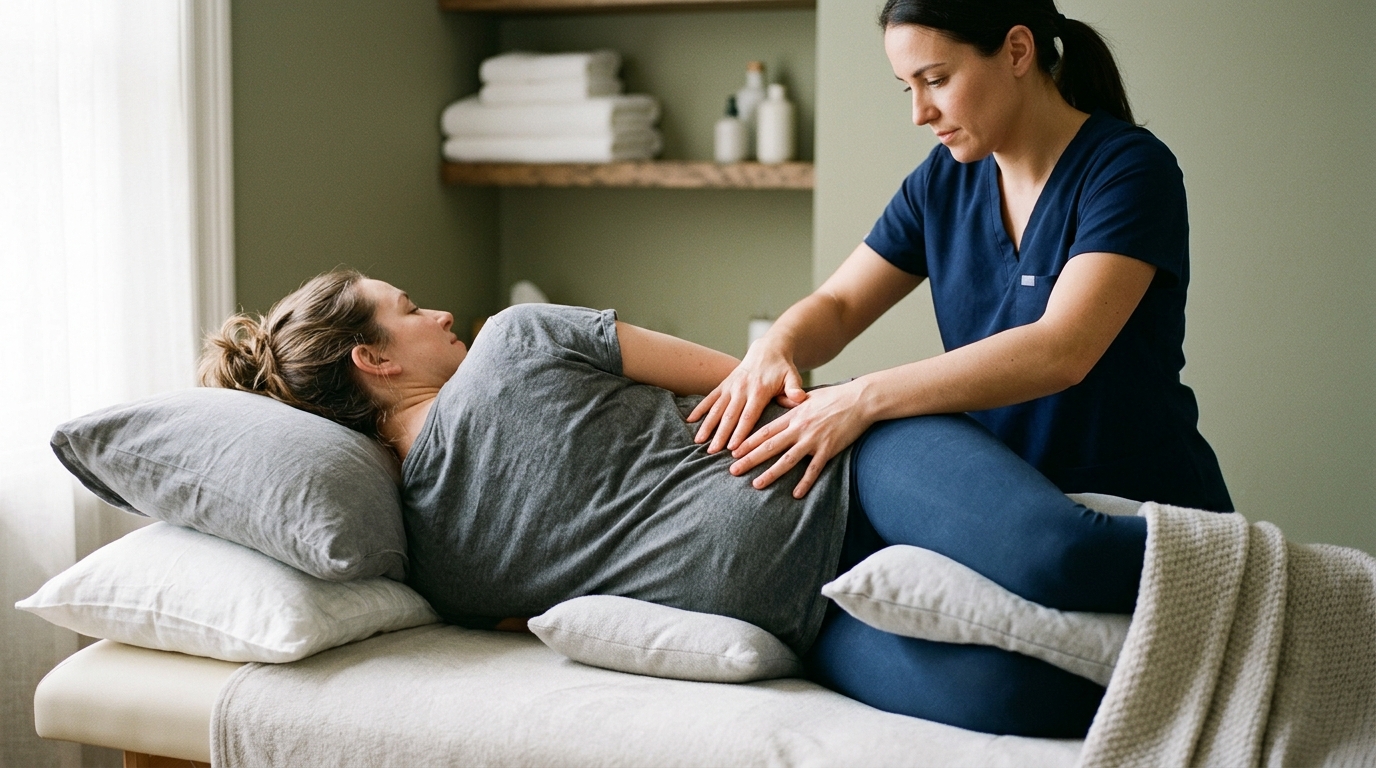
Prenatal massage is manual therapy adapted for pregnancy, and the adaptation is the whole point. A pregnant body carries weight differently, holds more fluid, and goes through hormonal changes, relaxin among them, that are associated with looser ligaments and joints that can feel less stable than they used to. A therapist trained for this adjusts three things: where you lie, how much pressure goes in, and which areas get worked at all.
Most prenatal sessions are given side-lying, with bolsters or wedge cushions supporting the belly, the top knee and the upper arm. Face-down positioning stops being workable fairly early. Trained providers also tend to avoid leaving someone flat on the back for long stretches later in pregnancy, because the weight of the uterus can press on the vena cava and reduce blood return to the heart. Pressure is usually lighter than in a standard massage, and the work concentrates on the lower back, hips, shoulders and legs.
A careful provider starts with an intake, not a table. Expect questions about how many weeks along you are, whether the pregnancy has been flagged as high risk, whether you have had preterm labor before, and whether there is any clotting history, raised blood pressure or swelling that came on suddenly. Those questions are not paperwork for its own sake. They change what the therapist does, and sometimes they end the appointment before it starts.
People come to prenatal massage for back and hip pain, for swelling, for sleep, and for the plain relief of an hour where nothing is asked of them. The research behind those reasons is thinner than most pages selling it suggest. Studies exist, several report lower pain and anxiety scores afterward, and most are small, short and difficult to blind. That is worth knowing in both directions. It is not a treatment with a strong evidence base, and it is also not fringe. It is a comfort measure that many people find genuinely helps, offered inside sensible limits by someone trained to recognize those limits.
In New Jersey, massage therapists are licensed by the State Board of Massage and Bodywork Therapy, which sits inside the Division of Consumer Affairs. A license means a required number of training hours, an exam, and a public record you can look up by name. That lookup is free and takes about a minute, and it is the single most useful thing anyone can do before booking bodywork of any kind.
Prenatal work sits on top of that license. There is no separate prenatal license in New Jersey. What exists is continuing education: coursework in pregnancy anatomy, positioning, contraindications and postpartum recovery, running anywhere from a weekend to a full certificate program. So the useful question is not whether someone is licensed, which is the floor, but what prenatal training they have done, with whom, and how recently.
Some prenatal massage therapists work independently. Others work inside physical therapy practices, chiropractic offices, birth centers or hospital outpatient programs, where an intake process and a clinician are already part of the picture. If you are already seeing an obstetric practice or a midwife, they are usually the best first ask. They refer within networks they know, and unlike any studio, they have your chart in front of them.
Two kinds of equipment get folded into massage content online, and neither one is massage.
Whole-body vibration means lying on or standing on a platform or table that oscillates, transmitting mechanical energy through the body. On a vibration table the movement usually travels upward from the feet through the legs and trunk. It shows up in fitness and wellness settings, marketed for circulation and muscle tone, and the sensation is often described as floaty and pleasant. Pleasant is not the same as appropriate.
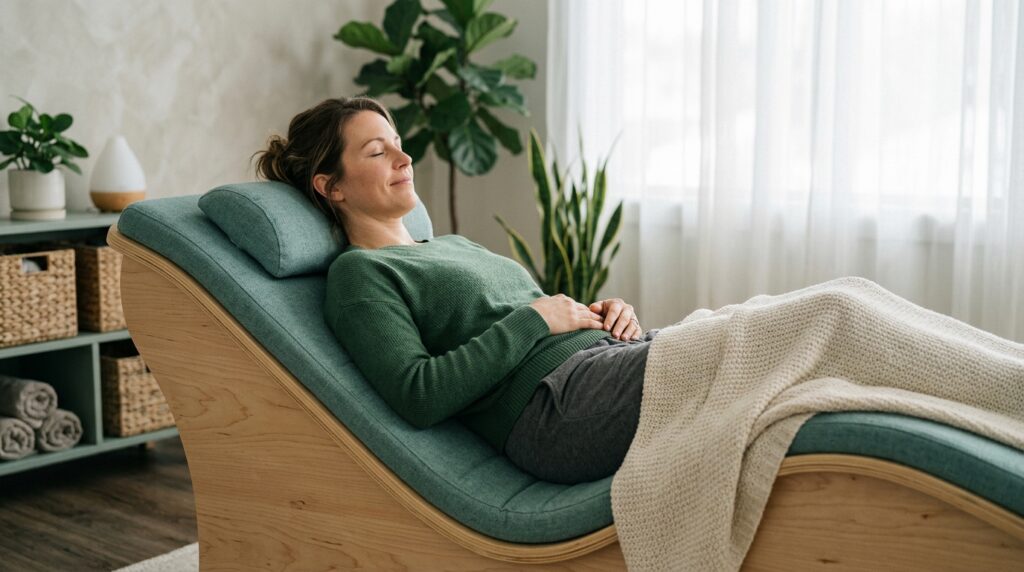
Inclined mechanical traction means a table that lifts and rocks, using the angle of the body and its own weight to create a pulling force along the spine. The aim is passive decompression. The mechanism is gravity and leverage applied to the whole trunk, repeatedly, for as long as the session runs. No one is modulating anything by hand while it happens.
Pregnancy appears as a contraindication for both. Whole-body vibration equipment is routinely marked as not for use during pregnancy, and occupational health research into vibration exposure, the kind that comes with driving heavy machinery for a living, has long treated pregnancy as a reason for caution rather than a settled question. Mechanical traction carries the same flag, with the added issue of sustained positioning and load through a trunk already under mechanical stress.
The honest summary is not that this has been proven harmful. It is that the studies which would establish safety have not been done and largely cannot be, because no one is going to randomize pregnant volunteers onto vibration equipment to find out. Without that evidence, the default across the industry is exclusion. The reasoning is the same reasoning most people would give if asked plainly: you do not run the experiment here.
The blurring is a vocabulary problem before it is anything else. Words like gentle, soothing, non-invasive and no deep pressure describe how something feels. They say nothing about whether it belongs in pregnancy. A machine can be completely comfortable and still sit on a contraindication list. A pair of trained hands can feel firm and still be entirely appropriate. Comfort is not a safety signal, and any page that treats it as one is answering a different question than the one you asked.
Fort Lee, Edgewater, Englewood, Teaneck and Hackensack all have bodywork providers within a short drive of one another, and the training behind them varies widely. If the clinician managing your pregnancy has already weighed in and prenatal massage is something you are free to pursue, a few concrete checks separate a properly qualified prenatal provider from a general one.
One more signal worth noticing is how a place handles a first phone call. Somewhere that asks how many weeks along you are before quoting a price is thinking about you. Somewhere that books you without asking is thinking about the calendar.
The postpartum version of this question comes up just as often, and it deserves a straighter answer than it usually gets. Recovery after birth is not one timeline. A straightforward vaginal delivery, a cesarean, a long labor, heavy bleeding, blood pressure that stayed high, abdominal separation, a repair that is still healing: each of these changes what is reasonable and when.
This article will not tell you when to resume massage or any other bodywork after birth, and neither should a studio, a blog or a booking page. That call belongs to the clinician handling your postpartum care, who knows how the delivery went and what your recovery looks like week to week. A business that hands you a number without knowing any of that is guessing. The caution attached to vibration and traction equipment does not switch off the day a baby arrives either, and that is another thing to raise with your own clinician rather than with a front desk.
Anmowell is an appointment-based wellness studio in Fort Lee, and it does three things. A 30 minute session on the Wave Table, an inclined table that rocks to produce passive spinal traction. A 10 minute session on the Sonic Table, which delivers whole-body vibration from the feet upward. Then a 5 minute finishing massage of the back and shoulders with a handheld massager. Guests stay fully clothed for all three stages.
That list is the entire menu, which makes the rest simple to state. Anmowell does not offer prenatal massage or postpartum massage. There is no licensed massage therapist on staff providing Swedish, deep tissue, sports, lymphatic drainage, myofascial or any other clinical modality, and nothing on the menu is hands-on massage therapy. The studio does not put pregnant guests on either table. The handheld massager is the closing stage of that session rather than a service sold on its own, so there is no trimmed-down version of the visit either. A guest who is pregnant, or who thinks she may be, is asked to take the question of bodywork to her own doctor or midwife, and the session is not booked. That is the answer on the phone and it is the answer here.
No. Prenatal massage is manual therapy delivered by a trained person and adjusted in real time to the body on the table. Whole-body vibration is mechanical energy delivered by a machine at a set intensity. They feel different, they carry different risk profiles, and pregnancy sits on the contraindication list for one of them and not the other.
Policies vary, and every business sets its own. What you can do is ask the direct question: is this equipment listed as contraindicated in pregnancy, and on what basis is it being offered anyway. Then take the answer to the person managing your pregnancy and let them weigh it, because their reading outranks any studio, including this one. Anmowell’s own position is the one stated above, and it is not decided case by case.
Mention it at your next contact with your doctor or midwife, with the date and roughly how long the session ran. They have your history and can tell you whether it matters. That is a question for them rather than for a website, and it is worth asking plainly instead of worrying about it quietly.
Because the search term is the same and the adjectives are the same. Pages get written to answer a question that was already posed in a leading way, and the easy answer is the one that keeps a reader moving toward a booking. A pregnant reader is not the same reader as someone with a stiff back, and an honest version of this topic has to say so out loud.
The short version is worth keeping. Prenatal massage is a trained pair of hands, adapted to a pregnant body, provided by someone whose license you can verify in about a minute. Whole-body vibration and inclined traction are machines, and pregnancy appears on their contraindication lists because the evidence that would clear them was never gathered. Marketing language flattens that difference because flattening it makes both sound like the same soothing hour. The distinction is real, and it is worth holding onto the next time a page calls something gentle without telling you what it actually is. Everything past that, including whether any bodywork at all belongs in your pregnancy or your recovery, is a question for the doctor or midwife who knows your chart.
Temporary closure
The studio is closed while our team is away. You are welcome to book ahead for after we reopen.
Thank you for your patience. See you soon.