
Is massage safe for arthritis? What helps stiff, achy joints, what to avoid, and why seniors in Fort Lee choose gentle, no-pressure Wave & Sonic sessions.


Is massage safe for arthritis? What helps stiff, achy joints, what to avoid, and why seniors in Fort Lee choose gentle, no-pressure Wave & Sonic sessions.

Arthritis has a way of shrinking your day. Mornings start slow because your hands and knees need time to loosen. Stairs take planning. The things you used to do without thinking, like getting out of a chair or turning to look behind you in the car, start to require a strategy.
A lot of people with stiff, achy joints have heard that massage can help, and then hesitated. Will it hurt? Is it safe? Do I really want to undress and have someone press on a swollen knee?
Those are fair questions. Here is what massage for arthritis can realistically do, what to avoid, and why a gentle, no-pressure alternative can be a better fit.
There are two common types:
In both cases, the pain is not only in the joint. The muscles around a sore joint tighten up to protect it. That guarding reduces range of motion, restricts blood flow, and creates a second layer of stiffness on top of the arthritis itself. This is the layer massage can reach.
Yes, with the right approach. Massage does not rebuild cartilage or cure inflammation. What it does is:
The research on massage for osteoarthritis, especially knee osteoarthritis, is encouraging: regular sessions have been linked to less pain and better function over several weeks.
This is the part most articles skip. Not all massage is a good idea for arthritic joints.
At Anmowell in Fort Lee, we do not do hands-on deep pressure at all. A 45-minute session uses two gentle therapy tables and ends with a light handheld massage:
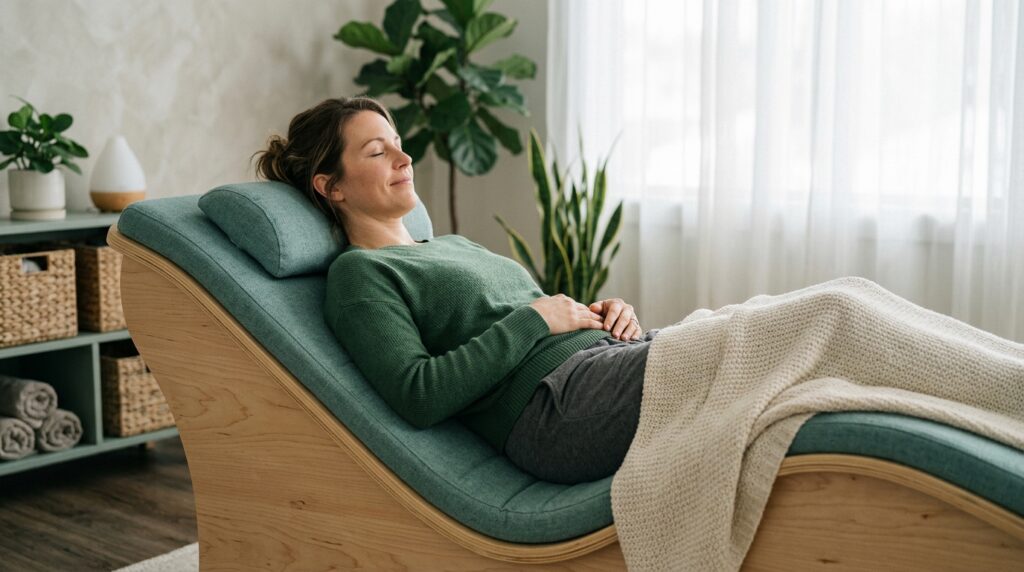
Wave Table (30 minutes). You lie fully clothed on a table that moves your body in a slow, rhythmic wave with a gentle incline. It lengthens the spine and gently mobilizes the hips, back, and shoulders, the way a good slow stretch does, but with no effort on your part and no one pushing on you. For stiff hips and a stiff lower back, this is usually the stage guests notice most.
Sonic Table (10 minutes). Soft vibrations travel from the feet upward through the whole body. Vibration relaxes muscle, encourages blood flow, and, according to a growing body of research on whole-body vibration, can support joint comfort and mobility in older adults. Our post on whole-body vibration therapy benefits covers that research in plain language.
Handheld finish (5 minutes). A light pass over the back and shoulders. Broad, gentle contact, never digging into a joint.
What makes this work for seniors:
If sciatic-type pain down the leg is part of your picture, our guide to massage for sciatica explains how the same gentle approach applies.
Arthritis is a long game, so think in weeks, not single sessions:
Your first session is $38. A 4-session bundle is $200 and a 10-session bundle is $400, which brings a weekly routine down to $40 a visit. See the pricing page for details.
If you are booking for a parent who needs something gentle, a few practical tips:
Is massage safe for someone with arthritis?
Gentle massage is generally safe and often helpful for osteoarthritis. Avoid deep pressure on inflamed joints, and skip sessions during an active rheumatoid flare. When in doubt, ask your doctor.
Can vibration therapy help joint pain?
Research on whole-body vibration in older adults suggests it can support muscle strength, circulation, and joint comfort. Our sessions use a gentle, low-intensity setting with no pressure on the joints.
Is it okay after a knee or hip replacement?
Check with your surgeon first. Once you are cleared, tell us when you book so we can adjust the tables.
Do I need to undress?
No. You stay fully clothed for the whole session, and there is no oil.
How soon will I feel a difference?
Most guests feel looser right after their first session. Lasting improvement in stiffness usually shows up over three to four weekly visits.
Ready to try something gentle? Book your first session for $38 at Anmowell in Fort Lee, NJ, or call (201) 429-2265. Our services page has a full description of each stage.
Temporary closure
The studio is closed while our team is away. You are welcome to book ahead for after we reopen.
Thank you for your patience. See you soon.