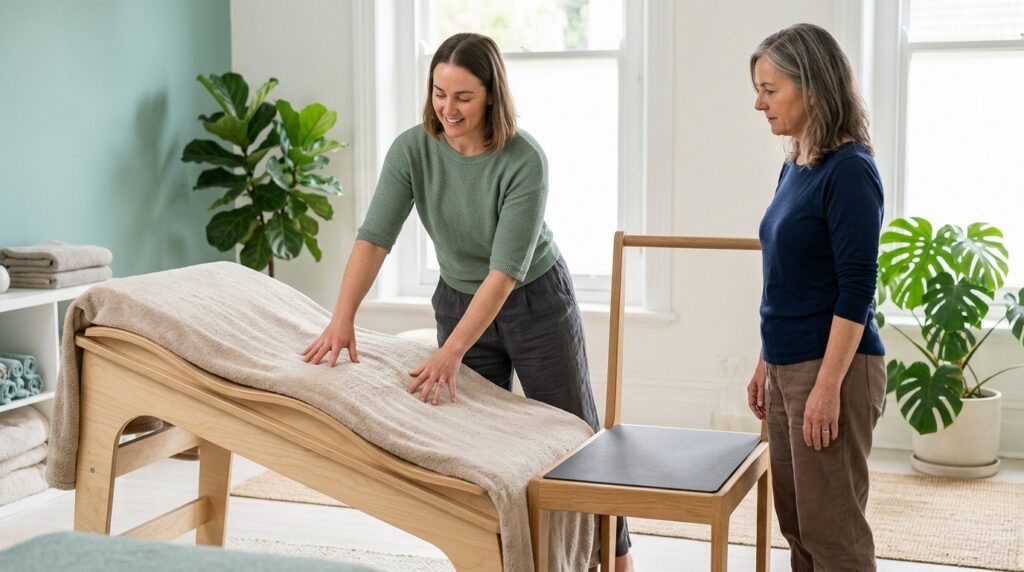
How the massage therapy franchise model works and how chain locations compare with an independent Fort Lee wave and sonic table studio.




You’ve seen the familiar strip-mall storefronts promising quick relief, and you’ve probably wondered if a national massage therapy franchise really delivers the same care as a dedicated local studio. Fort Lee has no shortage of options. Not all sessions are created equal, though. Price and convenience matter, sure. So does knowing exactly who’s putting their hands on you and why it matters for your results in 2026.
A massage therapy franchise works a lot like a fast-food chain. A corporate office develops the brand, the training manual, and the service menu, then sells the rights to run a location to an individual owner-operator. That operator pays an upfront franchise fee, often tens of thousands of dollars, plus ongoing royalties, usually a percentage of monthly revenue. In exchange, they get a recognizable name and a proven system. What they don’t get is much say in how the massage itself is designed.
That’s because pricing, session lengths, and add-on packages are usually locked in at the corporate level. Not decided by the person greeting you at the front desk. A 50-minute session costs the same in one state as it does three states away, give or take a small regional adjustment. If corporate decides to phase out a modality or bundle it differently, every location follows, whether local demand supports it or not. If you’re comparing options, look at structure and pricing before assuming locations are interchangeable.
Uniformity is the whole point, honestly. Chains want a client in Ohio to get the same experience as one in New Jersey, because consistency builds trust at scale. Independent studios play a different game entirely. Without a corporate playbook, they design their own treatments, set their own hours, and adjust pricing based on what their actual neighborhood needs. Some build sessions around modalities you won’t find in a franchise menu at all, and researching a wave and sonic massage therapy guide makes the contrast pretty obvious. Freedom cuts both ways: no safety net, but no cookie-cutter menu either.
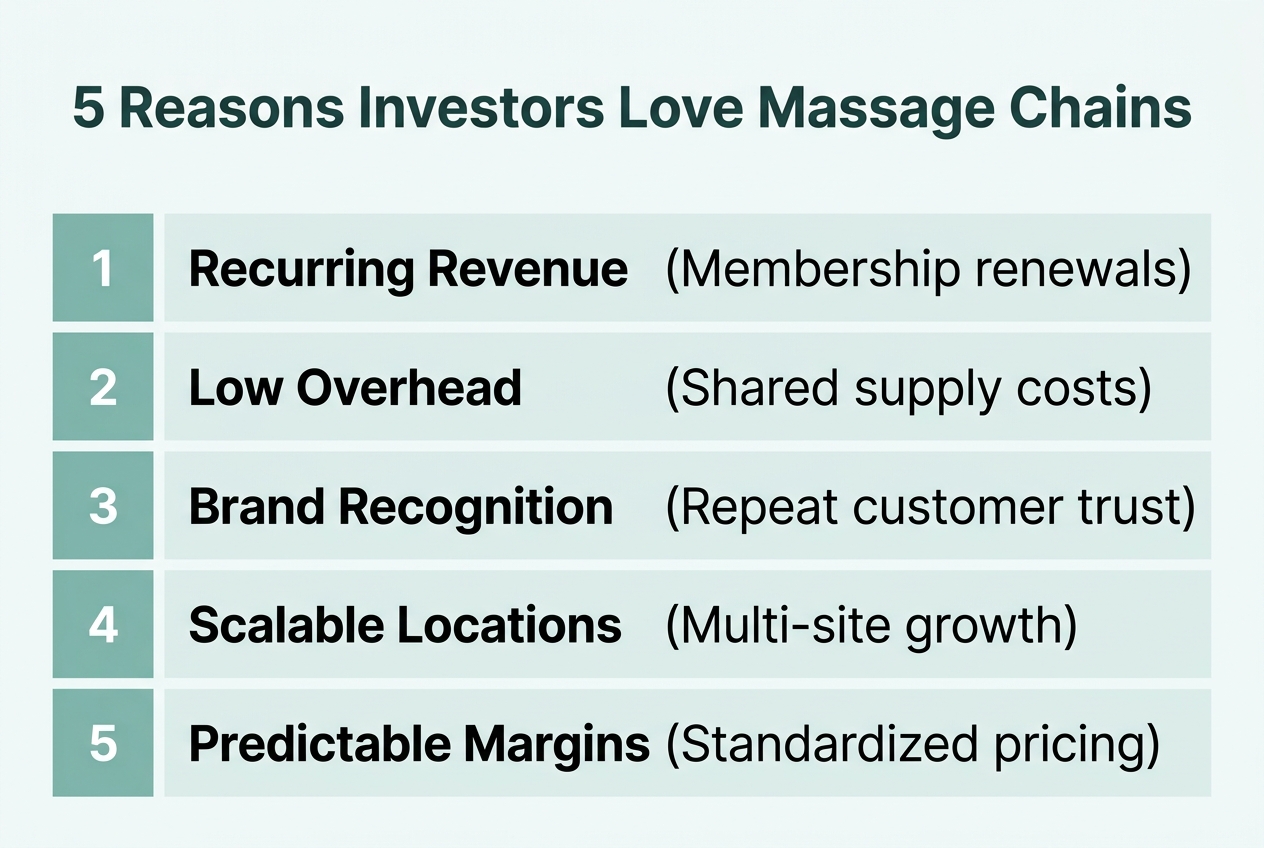
Franchises don’t spread across the country by accident. There’s real money behind the model, and understanding why investors love it explains a lot about what you’ll experience walking into a chain location versus a smaller studio. Some people research franchise opportunities the same way they’d shop for a rental property. That’s worth knowing before your next appointment.
Here’s the catch. None of those five points mention your neck, your back, or your actual session. A system built to reduce investor risk isn’t the same as a system built around your comfort. Staffing, training, and pricing practices vary from one location to the next, so ask directly. A smaller studio, by contrast, usually lives or dies on repeat clients and word of mouth — which tends to push care quality higher, not lower. It’s also worth building a massage self care routine around whichever setting you choose, since consistency matters more than the logo on the door.

Big-name chains run on scale. That often means standardized hourly menus and membership sign-ups. A local, family-run studio works differently: one fixed protocol, one team, no upsell script. Neither model is “wrong,” but they solve different problems. If you want predictability and control over who touches your body and how, the differences below matter more than they might seem at first glance.
| Factor | Typical Franchise Chain | Independent Wave & Sonic Studio |
|---|---|---|
| Ownership & staff | Often independently owned under a corporate brand; staff vary | Family-owned team |
| Cost structure | Hourly rate plus recurring membership fees | Flat session, bundle, or unlimited pricing |
| Session length | 50-60 min standard hour, add-ons extend it | 45-minute fixed three-stage sequence |
| Technique | Deep-tissue, Swedish, hot stone, sports menus | Wave Table, Sonic Table, handheld finish |
| Clothing / oil use | Disrobed, oils and lotions applied | Fully clothed, no oils, no direct pressure |
| Language support | Varies by location and staffing | English, Mandarin, and Cantonese on site |
Pricing transparency is the biggest gap. Some chains add membership offers and upgrade charges to a base rate, so ask for the full price. A fixed-menu studio keeps it simpler, though Anmowell, like most studios, has a 24-hour cancellation policy. Staff consistency matters too. If you’re dealing with chronic tightness, someone unfamiliar with your history has to relearn it each visit, while researching vibration therapy near me fort lee options can help you spot which nearby providers actually keep a stable team.
Technique flexibility cuts the other way. Chains offer more variety on paper: hot stone, sports massage, prenatal, deep tissue. A three-stage protocol doesn’t flex like that. What it does offer is repeatability. Same sequence, same intensity controls, no guessing which therapist’s “medium pressure” you’ll get. For circulation-focused goals specifically, reviewing evidence on massage for better circulation is a useful way to judge whether a fixed, oil-free approach fits your needs better than a rotating deep-tissue menu.
A lot of people have a specific hesitation about massage, and it’s not about whether it works. It’s the oil, the disrobing, the awkward draping. A fully clothed format removes that friction entirely. You lie down dressed, in whatever you came in wearing, and the session moves forward without any of the usual prep. For anyone who’s skipped booking a massage purely because of the logistics, that’s a real barrier gone.
There’s also the pressure question. Traditional deep-tissue work can leave you sore for a day or two, which isn’t everyone’s idea of relaxing. This approach skips deep pressure altogether, relying instead on rhythmic motion and vibration to do the work. If you’re managing tension from sitting at a desk all day, learning how massage for stress relief actually reduces cortisol and muscle guarding helps explain why a gentler method can still deliver a noticeable release.
The session opens with the longest segment: 30 minutes on an inclined table that moves in a slow, repeating wave pattern. The motion gently stretches and decompresses the spine, section by section, without any manual pressure applied. A heated eye mask goes on during this stage, which sounds like a small detail but does a lot for helping you actually settle into it instead of watching the clock.
Wave Table intensity is adjustable, so someone after a long run and someone with desk-job stiffness can each choose a comfortable setting, though a lighter setting does not make the table suitable for anyone on its contraindication list.
Next comes 10 minutes of vibration therapy, starting at the feet and working upward. This stage is designed to stimulate circulation and ease muscular tension. Vibration plates and handheld vibration devices have also grown common in gyms, and vibration massage back pain relief covers what the research does and does not show. No oils are used at any point.
The final five minutes bring in a handheld device, focused entirely on the back and shoulders. This is the one personalized part of the session. If your shoulders have been locked up all week, the team member can spend those minutes exactly there. Short, targeted, and adjustable. It’s a small stage, but it’s often what people remember walking out.
Most people don’t book a wellness session because they read about it online. They book because something hurts, or something’s stiff, or sleep just isn’t happening anymore. This style of therapy tends to show up as a solution for a fairly predictable set of complaints, and it’s worth naming them plainly rather than dancing around vague wellness language.
Anyone dealing with chronic tightness in that first category should look into massage for neck and shoulder pain as a starting point before assuming stronger pressure is the only fix. And if you’re comparing your options locally, reading up on best massage spa fort lee nj searches turn up is a reasonable way to sanity-check a provider before you commit to a package. None of this replaces medical care, to be clear. But for the everyday aches most of us walk around with, it covers a lot of ground.
Pricing structures in this space usually break down into a handful of familiar tiers. A single session pass suits someone testing the waters or dropping in occasionally after a rough week. The 4-session and 10-session bundles work better for regular maintenance, spacing out Wave Table and Sonic Table sessions over a month or two. Frequent clients often land on a monthly unlimited membership instead, since the math tips in their favor once visits pass a certain threshold. New clients typically start with a discounted first session, priced well below the standard rate, and every visit comes with tea service and a heated eye mask included at no extra charge.
Here’s where it gets useful. National chain memberships often lock you into monthly billing, add-on fees for upgraded modalities, and cancellation penalties buried in fine print. A pay-as-you-go or bundle model skips most of that friction. Before booking anything, reading through first visit what to expect helps you understand what’s included before you commit to a tier. The table below breaks down a rough comparison.
| Pricing Tier | Typical Structure | Best Fit For |
|---|---|---|
| Introductory session | $38 flat rate, no commitment | First-timers deciding if the therapy fits |
| Single session pass | One-time rate, no expiration pressure | Occasional visitors, gift purchases |
| 4-session bundle | Discounted per-session rate | Monthly maintenance routines |
| 10-session bundle | Lower per-session cost, bulk savings | Consistent, long-term wellness plans |
| National chain membership | Recurring monthly fee, rollover limits, contract terms | Frequent users willing to commit long-term |
Notice the difference: bundles and passes scale with actual use, while recurring memberships bill whether or not you visit. If you’re unsure which tier fits your schedule, it’s worth reaching out directly; the contact us page lists hours and a phone line for quick questions before you book. Either way, compare total monthly cost against actual visit frequency, not the sticker price alone.

If you sit at a desk eight or nine hours a day, your body knows it. Tight hips, a stiff neck, that dull ache between the shoulder blades that never fully goes away — sound familiar? Wave Table therapy works this kind of tightness loose through slow, rhythmic inclines rather than deep pressure, which makes it a realistic option for people who can’t take an hour off to nurse soreness. A 45-minute session can fit into a long lunch break.
Runners and weekend athletes need something different: recovery that doesn’t add more stress to already-worked muscles. Sonic Table therapy delivers vibration from the feet upward, easing tension without added pressure, though it is not for anyone with acute inflammation. It’s a gentler cousin to foam rolling or percussion guns, minus the effort. For anyone managing swelling or sluggish circulation after hard training, it also helps to understand lymphatic drainage massage benefits, which explains how that separate clinical technique works.
Seniors and children need low-impact care, and intensity settings on the Wave Table and handheld massage stages allow some flexibility, though a lighter setting does not make the tables suitable for anyone on their contraindication lists. There’s no oil, no deep pressure, and clients stay fully clothed throughout — details that matter for older joints or a nervous kid. Multilingual households also benefit when a team communicates comfortably in English, Mandarin, and Cantonese, removing a barrier that too many wellness spaces overlook entirely.
And if traditional deep-tissue work has ever left you wincing, you’re not alone. Plenty of people avoid massage altogether because of pain sensitivity, not because they don’t need the relief. This style skips that problem completely. Worth noting: some larger chains structure their offerings around a franchise model built for volume and consistency, which is fine, but it rarely leaves room for the kind of gentle, adjustable approach sensitive clients actually need.
Wellness studios in this space don’t run on walk-in traffic. Most operate by appointment only, and hours are often tighter than a typical spa chain. A common schedule looks like this: Monday and Thursday are appointment-only with no drop-ins, Tuesday and Wednesday closed entirely, Friday and Saturday open 10am to 8pm, and Sunday running a shorter 2pm to 8pm window. That’s a deliberate structure, not a scheduling accident. Smaller studios keep hours tight so each session gets full attention instead of being rushed.
Most reputable studios ask for 24 hours’ notice before you cancel or reschedule. It’s not a punishment — it’s how a small, appointment-based business protects its limited time slots. Miss that window and you may forfeit part of your session cost, especially with bundle packages. Plan ahead, and it’s a non-issue.
Before you go, a little prep makes the visit smoother. Consider the following:
One more thing worth knowing: reading up on massage wellness near you bergen county options ahead of time helps you compare what’s actually nearby versus what just shows up first in a search.
Recovery isn’t one-size-fits-all, and the right choice often comes down to what your body needs on a given day, what a professional has cleared you for, and whether you’re looking for hands-on therapeutic work or a different kind of session altogether. Some people want the targeted pressure and clinical judgment only a trained therapist can provide, while others are simply after a quieter way to unwind without disrobing or being touched. Whatever you decide, it’s worth checking with your doctor if you have any medical condition, recent injury, or ongoing treatment before trying something new.