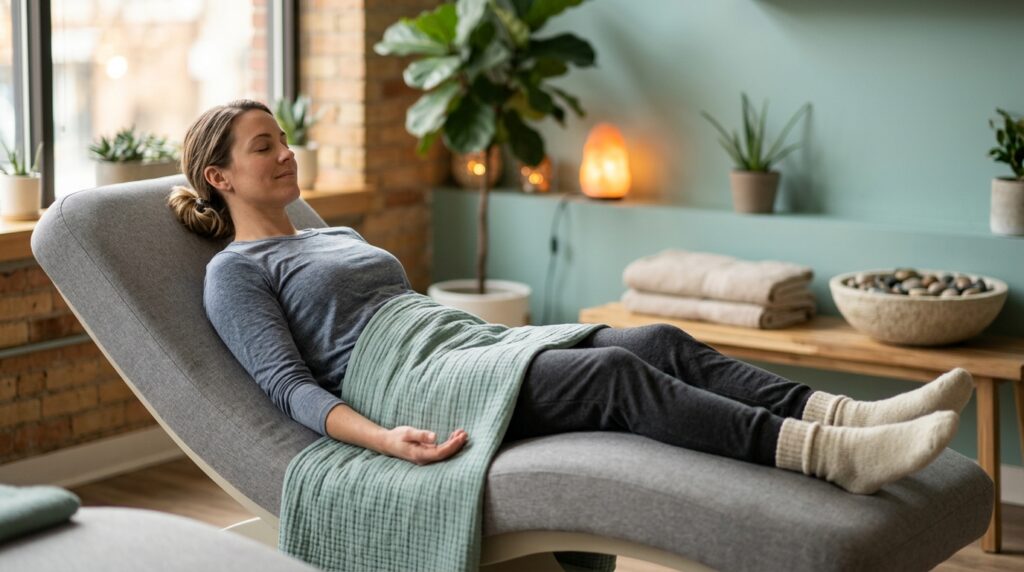
Acupressure massage explained: origins, how sessions work, and how it compares to deep-tissue, plus a pressure-free take using Sonic and Wave Table therapy.


Tight shoulders. Tension headaches. That dull ache between your shoulder blades that just won’t quit—sound familiar? You’ve probably tried stretching, painkillers, maybe even a foam roller, but the relief never sticks. Acupressure massage is one well-known approach to that kind of tension, rooted in centuries of practice, and it’s worth understanding on its own terms before you decide what fits your body. If you’re in Fort Lee, NJ, this guide breaks down how acupressure works, where to find it, and what Anmowell offers instead if a pressure-point session isn’t the direction you want to go in 2026.
The idea goes back thousands of years to traditional Chinese medicine. The theory holds that energy, or qi, flows through the body along specific pathways called meridians. When that flow gets blocked or sluggish, discomfort and tension supposedly follow. Pressing on specific points along those meridians is meant to clear the blockage and restore balance. It’s a simple idea, really. Whether you buy into the energy framework or not, the practical result — targeted pressure easing tight spots — is what’s kept it around this long.
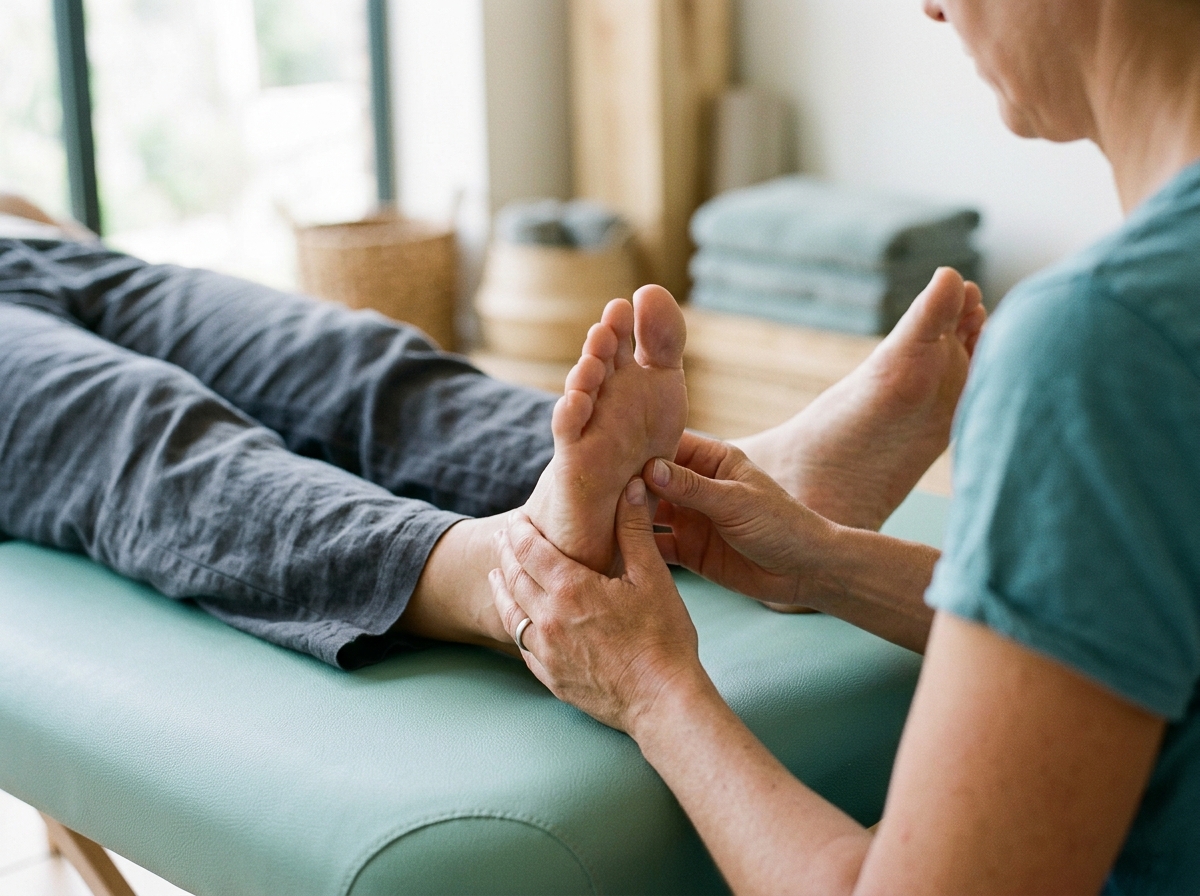
People often lump this in with acupuncture, but they’re not the same thing. There are no needles involved, ever. Instead, pressure comes from fingers, thumbs, palms, elbows, or increasingly, mechanical tools built to mimic that same touch. If you’re curious about the finer points, it’s worth reading up on how acupressure differs from massage therapy before assuming the two are interchangeable. They share a family tree but work in very different ways. Acupressure itself is a hands-on, point-specific technique performed by trained practitioners elsewhere — it is not part of what Anmowell offers.
Plenty of people love traditional finger-pressure work. Plenty of others find it too intense, especially on sensitive areas like the neck, feet, or lower back. Sustained thumb pressure can bruise or leave someone sore for days afterward — not exactly relaxing. That discomfort has pushed some people toward a different kind of session altogether: one built around whole-body vibration and passive motion rather than point-by-point pressure. Anmowell’s approach falls into this second category, and it’s worth being clear that it’s a different tool solving an adjacent problem, not a substitute for acupressure itself.
This is where Anmowell fits in. The studio’s Handheld Massage tool finishes every session with light, adjustable pressure across the back and shoulders, but it’s general muscle relaxation, not point-targeted work aimed at specific meridians. The Sonic Table, separately, delivers vibration therapy moving from the feet upward to stimulate circulation across the whole body at once — again, no probing, no point-mapping, no meridian theory involved. A gentler entry point matters, too, if you’re weighing options; understanding orthopedic massage techniques (a clinician-led category Anmowell does not provide) can help clarify how pressure-based recovery methods differ across the wellness spectrum, and where a whole-body vibration alternative like the Sonic Table might fit instead. The tools have changed. The goal for Anmowell’s tables — general relaxation and circulation support, not tension “release at the source” via pressure points — is narrower than acupressure’s, and that’s by design.
Walk into most acupressure sessions and the first thing you’ll notice is what’s missing: no gowns, no oils, no awkward draping. You stay fully clothed. That’s the norm, and it makes the whole experience feel less clinical and more like a quick reset in the middle of your day. A practitioner’s hands apply steady, rhythmic pressure to spots that hold tension, without the digging or kneading you’d get from a deep-tissue session.
Acupressure sessions tend to follow a logical arc rather than jumping around at random. A few things generally hold true no matter where you book one:
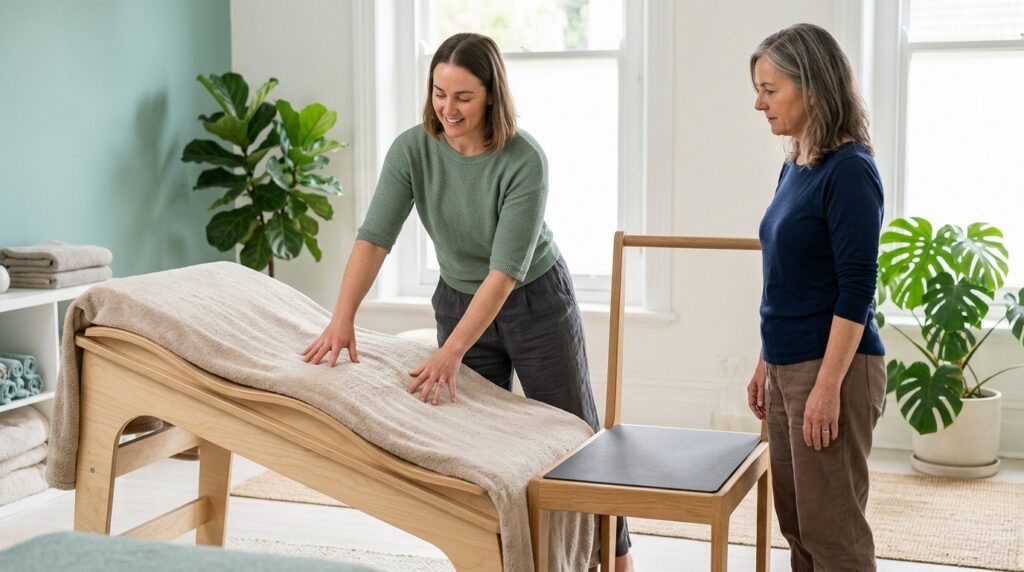
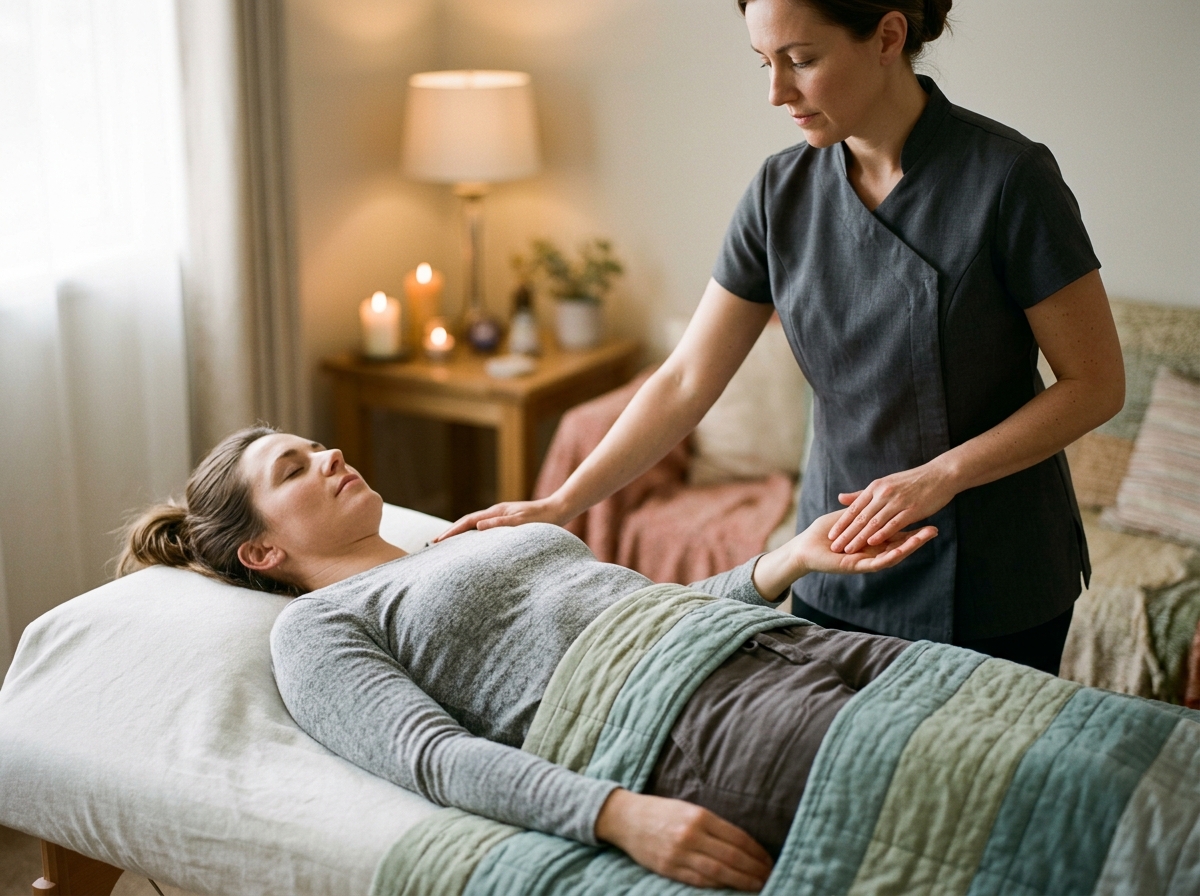
Anmowell’s own format is built differently and doesn’t attempt to replicate that point-by-point structure. A session there opens with the Wave Table’s rhythmic, inclined motion for spinal decompression, moves to the Sonic Table’s whole-body vibration to support circulation from the feet up, and closes with a short Handheld Massage segment for general tension in the back or shoulders — no meridian points, no sustained finger pressure. If you’re curious about the mechanics behind the vibration side of things, it helps to review hydromassage benefits before booking, since dry vibration tables and water-jet hydromassage beds get compared often, even though they’re different equipment entirely — Anmowell’s tables are dry, not water-based. Anyone considering acupressure as a career path, rather than just a client experience, might look into formal acupressure training to understand how practitioners are actually taught to sequence pressure and pacing; that training path is unrelated to what Anmowell’s staff are trained to operate.
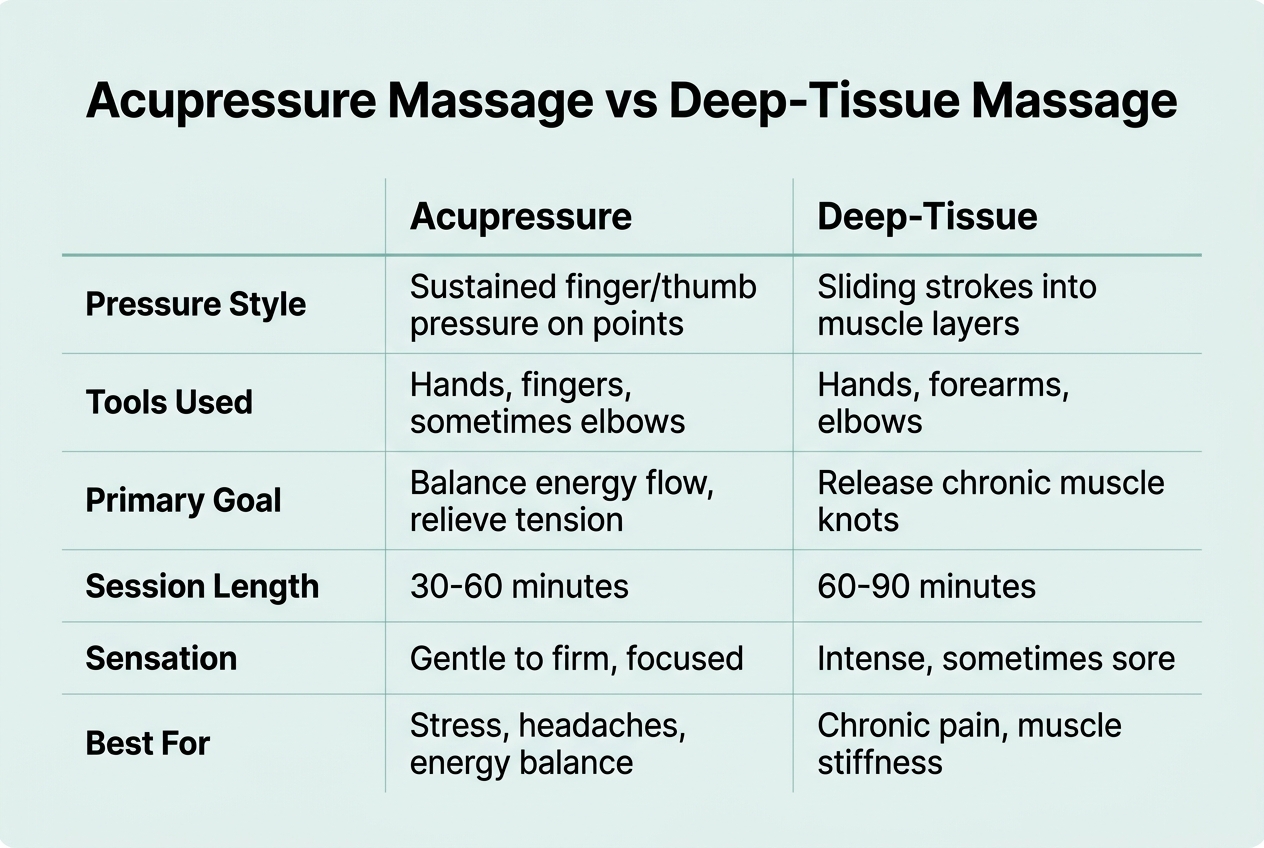
People lump every kind of bodywork into one category. But the three approaches worth comparing here work very differently in method and feel. Deep-tissue work leans on sustained, often intense manual pressure driven deep into muscle layers to break up adhesions — Anmowell does not offer deep tissue massage. Acupressure takes a different route, focusing on specific spots along the body rather than broad, sweeping muscle kneading — Anmowell does not offer acupressure either. Anmowell’s Sonic and Wave Table format is a third, separate category: whole-body vibration and passive inclined motion, with no manual point work and no deep manual pressure at all. That distinction changes everything else downstream — comfort, clothing, even who should book which session.
Here’s a quick breakdown of how these approaches stack up on the things that actually matter when you’re deciding what to book.
| Factor | Deep-Tissue Massage | Acupressure |
|---|---|---|
| Pressure style | Sustained, firm, often intense into muscle fibers | Targeted, steady manual pressure on specific points |
| Comfort during session | Can feel intense; soreness afterward is common | Generally gentler; less next-day soreness |
| Clothing and oils | Usually requires undressing and oil or lotion | Often fully clothed, no oils needed |
| Best fit for | Chronic knots, deep muscle release | Sensitive clients wanting targeted point work |
| Recovery focus | Breaking up muscle adhesions directly | Supporting circulation and nervous system calm via specific points |
Notice the pattern: deep tissue asks your body to tolerate more in exchange for a stronger, more localized release, while acupressure asks less of you physically while still working toward specific points along the body. Anmowell offers neither of these. What the Sonic Table and Wave Table provide is a third lane entirely — whole-body vibration and passive inclined motion, aimed at general circulation and relaxation rather than any specific muscle knot or meridian point. If you’re curious how gentler techniques actually support blood flow, research on massage for better circulation explains the mechanism well, and it’s a useful lens for understanding what vibration therapy can and can’t do compared to hands-on work. Neither deep tissue nor acupressure is objectively “better” than the other. One’s a wrestling match with your muscles; the other’s more like a conversation with specific pressure points. Someone wanting either of those experiences should look to a licensed massage therapist who offers them — Anmowell’s format is for a reader who wants a no-pressure, no-disrobing alternative for general relaxation, not a stand-in for either modality.
Acupressure’s rhythmic, pressure-point techniques don’t just feel nice in the moment. Practitioners and researchers describe real, measurable responses tied to targeted point stimulation: nudged blood flow, a calmer nervous system, tight tissue coaxed into letting go at specific sites. None of this requires deep force, which is part of why acupressure has stayed popular.
Here’s what’s described as happening beneath the surface during a well-structured acupressure session, compared with what Anmowell’s Sonic Table vibration is actually built to do:
Curious readers can ask a trained acupressure practitioner for simple at-home methods. Self-practice won’t replace a full session, and it is a separate thing entirely from booking time on Anmowell’s tables, which serve a different purpose.
If you sit at a screen for eight or nine hours a day, your neck and shoulders are probably paying for it. The forward-head posture that comes from staring at a monitor or phone shortens the muscles across your upper back and tightens the base of your skull. Over months, that tightness turns into a dull, constant ache. Learning more about massage for neck and shoulder pain helps explain why this area holds so much tension in the first place, whether you’re considering a point-specific acupressure session or a general-relaxation alternative like Anmowell’s Handheld Massage finish.
Lower back stiffness follows a similar pattern, whether you’re sitting all day or standing at a register for a full shift. Prolonged static posture reduces blood flow to the lower spine and surrounding muscles, which stiffens the area and can compress it further. Anmowell’s Wave Table stage works with gentle, passive inclined motion — not deep pressure and not targeted point work — to support that release, offering a different route to the same general goal that a lower-back-focused acupressure session pursues by other means.
Repetitive strain doesn’t stop at soreness. It also restricts how far your joints can comfortably move, which quietly reshapes your posture over time. Rounded shoulders. A tilted pelvis. A stiff neck that won’t turn fully to check a blind spot. These all start small. Left alone, they compound. That’s the part people underestimate.
Runners and weightlifters know the feeling: legs that ache for two days after a hard session, calves that stay tight no matter how much you stretch. Post-workout soreness comes from microscopic muscle damage and inflammation, and while that’s a normal part of building strength, it doesn’t have to linger. For readers researching a different technology entirely, an acoustic wave therapy guide explains focused acoustic pulses used in clinical settings — that is not what Anmowell offers. The Sonic Table uses whole-body vibration, a different mechanism, and is best understood as a between-training recovery option rather than acoustic or shock wave therapy, sports massage, or any clinical treatment.
Cold hands, cold feet, and fatigue that sleep doesn’t fix can have many causes and are worth raising with a doctor if they persist. The idea that faster blood flow clears soreness is not supported: one study found massage after strenuous exercise slowed lactic acid removal. The Sonic Table sends vibration from the feet upward to support circulation and ease muscular tension, but it is a circulation-support tool, not a clinical or medical treatment, and it is not a substitute for guidance from a doctor or physical therapist if soreness or injury is more than routine.
Then there’s the mental side. Sore muscles keep you tense, and tense bodies don’t sleep well. A calming, low-stimulation session can help quiet that mental noise, and understanding what is acupressure and how it works clarifies why targeted, gentle point-pressure techniques can shift the body from alert to relaxed for people who prefer that hands-on route. Anmowell’s short Handheld Massage finish, applied generally to the back and shoulders, aims at a similar calming effect through a different, non-point-targeted method.
Think of it as a relay, not three separate appointments. Each stage hands off to the next, building on what came before rather than repeating it. The table below lays out the sequence so you know exactly what’s happening and why, minute by minute.
| Stage | Duration | What Happens | Primary Goal |
|---|---|---|---|
| Wave Table | 30 minutes | Rhythmic inclined table motion with a heated eye mask | Spinal decompression and deep relaxation |
| Sonic Table | 10 minutes | Vibration therapy applied from feet upward | Stimulate circulation and wake up tired muscles |
| Handheld Finish | 5 minutes | Personalized, general attention to back and shoulder tightness | Ease leftover tension broadly, not at specific points |
| Full Session | 45 minutes | All three stages combined, back to back | Complete wellness reset in one visit |
Notice the direction of travel: decompress first, circulate second, finish general last. That order matters. Starting with Wave Table therapy loosens the spine through passive inclined motion and lets your nervous system downshift before anything else happens, and a detailed wave and sonic massage therapy guide breaks down how the incline angle contributes to that effect. From there, the vibration stage takes over. It shares some overlap in principle with whole-body vibration platforms used elsewhere for recovery, but it starts at the feet and works upward rather than jolting the whole body at once — and it is not sports massage or a clinical recovery protocol.
Anmowell asks every guest with any medical condition, recent injury, or ongoing treatment to check with their doctor before booking. The Sonic Table is not for guests who are pregnant or trying to conceive; who have a pacemaker, defibrillator, or other implanted electronic device; who have a known blood clot, deep vein thrombosis, or a clotting disorder; who have had surgery, a fracture, or a joint replacement in the last six months; or who have severe osteoporosis, an acute hernia, retinal detachment, epilepsy or a seizure disorder, an active cancer diagnosis, uncontrolled heart disease, or acute inflammation. The Wave Table is not for guests who are pregnant; who have uncontrolled high blood pressure, glaucoma or other raised eye pressure, heart disease, or a history of stroke; who have had spinal surgery, a spinal fracture, or a disc injury in the last twelve months; or who have spinal instability, severe osteoporosis, an acute hernia, or vertigo and balance disorders. Anmowell does not offer prenatal or postpartum massage, and asks guests who are pregnant, trying to conceive, or in the early postpartum weeks to check with their doctor before booking anything — the tables are not positioned as an alternative during that time.
No oils. No disrobing. No deep thumbs digging into knots, and no point-by-point pressure work either. For anyone who’s winced through a hard-pressure massage or found acupressure’s sustained point pressure too intense, that’s a relief, not a compromise. Intensity on both the Wave Table and Handheld Massage stages is adjustable, so a first-timer and a regular visitor can get equally appropriate sessions on the same afternoon — as long as neither falls into one of the contraindicated groups above. That flexibility is part of why the format appeals across a wide age range, and anyone with one of the conditions listed above should not book those tables, while anyone with another medical condition should check with their doctor first rather than assuming the tables are automatically gentle enough.
There’s real physiology behind the vibration piece, too. Research summarized in various studies on whole body vibration therapy benefits points to improved blood flow and reduced muscle stiffness in appropriate candidates, which lines up with what the Sonic Table stage aims to do for circulation. That is a different claim than saying the tables move lymph or perform lymphatic drainage — they don’t, and Anmowell does not offer lymphatic drainage massage. For readers specifically interested in the lymph side of circulation, lymphatic drainage massage benefits explains what that clinical, hands-on technique does differently from vibration.
Not everyone needs the same commitment level, and that’s the point of having options. A single session pass suits someone testing the waters or dealing with a one-off bout of stiffness after a hard workout. If you’re building a short-term routine, say, easing desk-job tension over a month, a bundle of four sessions gives your body time to respond without locking you into anything long.
Here’s a quick side-by-side to help you decide what fits your schedule and budget, current as of 2026.
| Option | Best for | Typical use case |
|---|---|---|
| Introductory $38 first session | New clients | Trying the Wave and Sonic Table format risk-free |
| Single session pass | Occasional visitors | One-off stiffness after a workout, curiosity visits |
| 4-session bundle | Short-term routine builders | A month of consistent stress relief |
| 10-session bundle | Regular maintenance | Ongoing posture or circulation support |
| Monthly unlimited membership | Frequent visitors, ongoing relaxation needs | Weekly or near-weekly sessions |
A word on planning ahead: most studios, including many local businesses offering appointment-based wellness work, require 24-hour cancellation notice. Miss that window and you may forfeit the session, so treat your booking like any other appointment worth keeping. It’s also smart to pair whatever schedule you choose with some outside reading; understanding Acupressure Points and Massage Treatment helps set realistic expectations for what a genuine acupressure practice can and can’t do, separate from what a vibration-based table session is designed for. Curious how circulation-focused work compares to other modalities? Reviewing lymphatic drainage massage benefits is a useful next step for understanding the difference between what vibration supports and what manual lymph work specifically targets. Bottom line: match the package, and the modality, to your actual goals and any caution points that apply to you — not your best intentions.
Before you book anything, ask how the work actually gets done. Some studios rely entirely on a therapist’s hands, delivering acupressure, deep tissue, or other manual techniques. Others, like Anmowell, use mechanical tables and a handheld device for a whole-body vibration and passive-motion format instead. Knowing which one you’re getting matters because it changes the whole feel of the session — hands can adjust to a specific point on the fly, tables deliver a consistent, general effect across the whole body. If the front desk can’t explain their method clearly in a sentence or two, that’s worth noting.
Next, ask the practical stuff: do you stay clothed, is oil used, and can intensity be adjusted mid-session? These sound minor until you’re lying there wishing you’d asked. Traditional acupressure and deep-tissue bodywork often involve bare skin contact and sometimes oils, while Anmowell’s format keeps guests fully dressed throughout on all three stages. If gentle, targeted point pressure is specifically what you’re after, reading up on how acupressure works can help you decide what to ask for by name at a studio that offers it — that is a different booking than a Wave or Sonic Table session.
Also ask about session length and what’s included, and — importantly — ask about contraindications. A reputable studio should be upfront that whole-body vibration and inclined traction aren’t right for every guest, including anyone pregnant or trying to conceive, anyone with a pacemaker or other implanted device, recent surgery, uncontrolled heart disease, or the other conditions listed for each table. Ask what a session includes and what it costs; at Anmowell every visit is the same 45-minute, three-stage session.
Boutique wellness studios rarely keep bank hours. Many run appointment-only days, close midweek, and open later on weekends — so check the schedule before you plan around it. A studio with a strong five-star reputation across well over a hundred reviews tells you something real: consistency. One glowing review means little. Dozens, sustained over months, mean the good experience isn’t an accident.
Language accessibility matters more than people expect, especially in diverse communities where a staff member who speaks your language can put you at ease during a first visit. Small comforts count too — free parking saves you circling the block, and a warm tea afterward turns a quick appointment into something closer to a reset. If you’re researching options nearby, comparing setups through a search for vibration therapy near me fort lee is a reasonable place to start.
Location convenience shouldn’t be underrated, either. Residents across Fort Lee, Cliffside Park, Palisades Park, Edgewater, Leonia, and Englewood are all within a short drive of local studios, which makes regular visits realistic instead of a hassle you keep postponing.
Ultimately the choice comes down to what your body actually needs right now, whether you’re looking for hands-on, point-specific acupressure work or a passive, no-disrobing whole-body vibration session, and whether any of the caution points above apply to you — since no single approach fits every goal or every guest. Anmowell does not offer acupressure, deep tissue, sports massage, prenatal or postpartum massage, lymphatic drainage, myofascial release, trigger point therapy, cupping, chair massage, medical massage, acoustic or shock wave therapy, or hydromassage; its Sonic Table Therapy, Wave Table Therapy, and Handheld Massage are offered instead as a general-relaxation and circulation-support alternative for readers for whom that fits. If you’re pregnant or trying to conceive, Anmowell’s tables are not an option; if you have a medical condition or a recent injury, or are in the early postpartum weeks, check with your doctor before booking anything, and treat any of the caution points above as a reason to ask questions first rather than assume every option is right for you. Taking a moment to weigh those factors, rather than picking based on convenience alone, is what makes the decision feel right afterward.