

Chiropractor or massage for back pain? Compare what each does, who it helps, and a gentle third option in Fort Lee, NJ with no cracking.



Chiropractor or massage for back pain? Compare what each does, who it helps, and a gentle third option in Fort Lee, NJ with no cracking.
If your back hurts, the two suggestions you will hear most are “go see a chiropractor” and “you should get a massage.” They sound interchangeable. They are not. They work on different tissues, feel completely different, and suit different kinds of pain.
This is a plain-English comparison of chiropractor vs. massage, followed by a third option many people in the Fort Lee area have never heard of: gentle spinal decompression and vibration therapy with no cracking, no pressure, and no undressing.
Most back pain involves both stiff joints and tight muscles, which is why people often bounce between the two and get partial results from each.
A chiropractor uses controlled, quick movements to adjust joints that are not moving well, most often in the spine. The goal is to restore range of motion and relieve nerve irritation caused by misalignment or restricted segments.
Best for:
Keep in mind:
Massage therapists work on soft tissue by hand: kneading, stretching, applying pressure to trigger points, and moving fluid through the body.
Best for:
Keep in mind:
If you are weighing medical or clinical options, our post on medical massage therapy explains when a referral-based approach makes sense.
Anmowell is not a chiropractor’s office and not a traditional massage studio. Our 45-minute session uses two therapy tables and a short handheld finish:
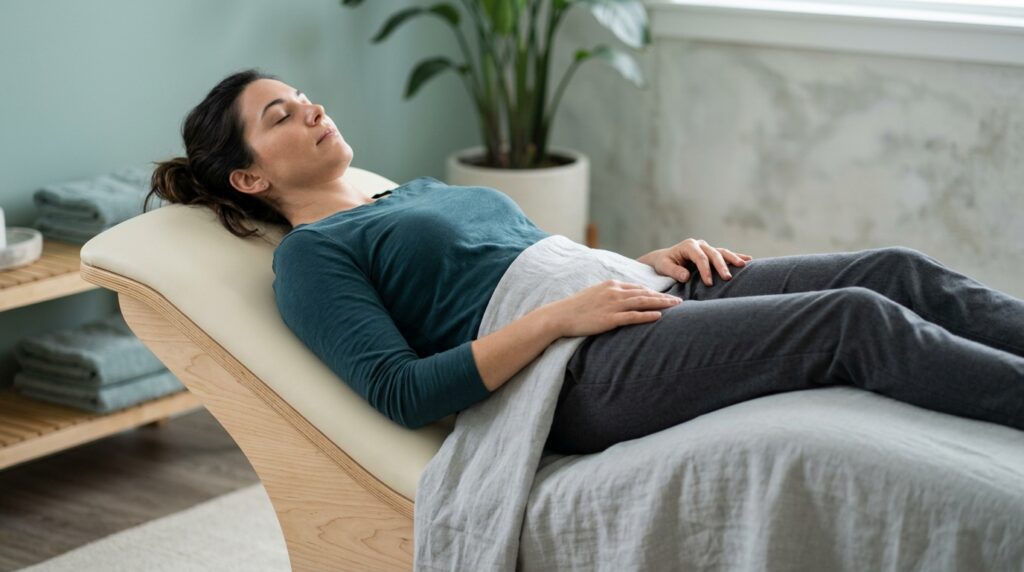
Stage 1: Wave Table (30 minutes). You lie on a table that moves your body in a slow, rhythmic wave with a gentle incline. That combination lengthens the spine and eases compression on the discs and joints, similar in spirit to what a chiropractor is trying to achieve, but gradually and without any sudden force. Meanwhile, the motion relaxes the muscles along your back that have been holding everything tight.
Stage 2: Sonic Table (10 minutes). Soft vibrations travel from your feet upward through the body. Vibration is one of the most reliable ways to relax muscle tissue and improve circulation without any pressure at all. It is where most guests feel their lower back finally let go.
Stage 3: Handheld massage (5 minutes). A light, targeted finish on the back and shoulders.
You stay fully clothed. There is no oil, no cracking, no pressure, and no soreness afterward. Our complete guide to Wave and Sonic therapy covers the science in more depth, and our post on vibration massage for back pain relief goes into the back-specific results.
| Chiropractor | Massage | Anmowell (Wave & Sonic) | |
|---|---|---|---|
| Works on | Joints, spine | Muscles, fascia | Spine decompression + muscles |
| Feel | Quick adjustments, cracking | Hands-on pressure | Gentle motion + vibration |
| Clothing | Clothed | Undressed, oil | Fully clothed, no oil |
| Intensity | Sudden, brief | Varies by therapist | Gentle, consistent |
| Soreness after | Sometimes | Common with deep tissue | Rare |
| Session | 10 to 20 min | 60 to 90 min | 45 min |
| Typical cost | $65 to $150 per visit | $90 to $150 per hour | $38 first visit, $40 to $60 after |
Costs for chiropractic and massage are typical U.S. ranges and vary by provider and insurance.
See a chiropractor (or your doctor) first if the pain came on suddenly after an injury, you have numbness or weakness in a leg, or you have lost bladder or bowel control. Those need a medical assessment.
Choose massage if your pain is clearly muscular, builds through the day, and eases with rest, and you enjoy hands-on bodywork.
Try wave and sonic therapy if:
Sessions work well alongside a chiropractor or physical therapist, not instead of them. Relaxed muscles make adjustments hold longer, and decompression between visits keeps the spine moving.
Your first session is $38. After that, single sessions are $60, a 4-session bundle is $200, and a 10-session bundle is $400. Full details are on our pricing page, and our services page describes each stage.
Is massage or a chiropractor better for lower back pain?
It depends on the source. Joint stiffness and nerve irritation often respond to chiropractic. Muscle tension responds to massage. Most lower back pain involves both, which is why a gentle approach that decompresses the spine and relaxes muscles together often works well.
Can I do both?
Yes. Many people alternate. Relaxed muscles help adjustments last, and decompression between visits keeps things moving.
Is Anmowell a chiropractor?
No. We do not perform adjustments or provide medical treatment. Our sessions use gentle wave-motion decompression and vibration therapy to relieve tension and stiffness.
Does the Wave Table crack your back?
No. The motion is slow and rhythmic. There is no sudden force and no cracking.
Is it safe if I have a herniated disc?
Check with your doctor first, and tell us about your condition when you arrive so we can adjust the intensity.
Curious how the gentle option feels? Book your first session for $38 at Anmowell in Fort Lee, NJ, or call (201) 429-2265. New here? Read what to expect on your first visit.
Temporary closure
The studio is closed while our team is away. You are welcome to book ahead for after we reopen.
Thank you for your patience. See you soon.